Home Blog

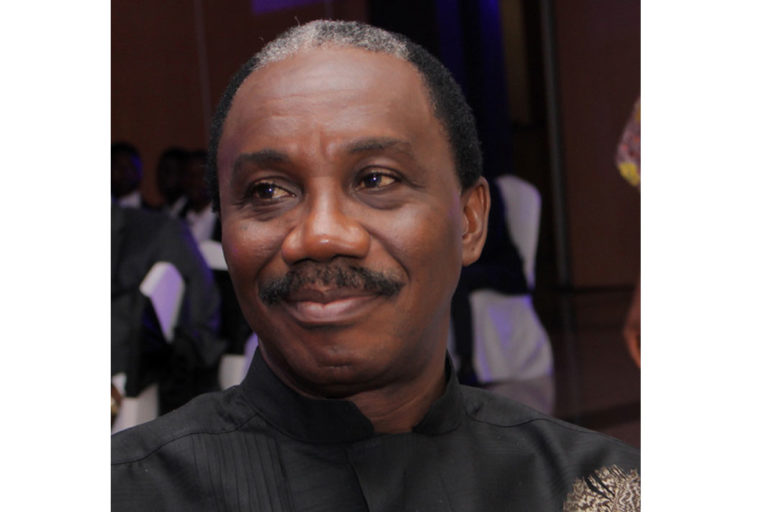
Professor Ernest Maduabuchi Ojukwu SAN: The inspiring profile of the Teacher

0

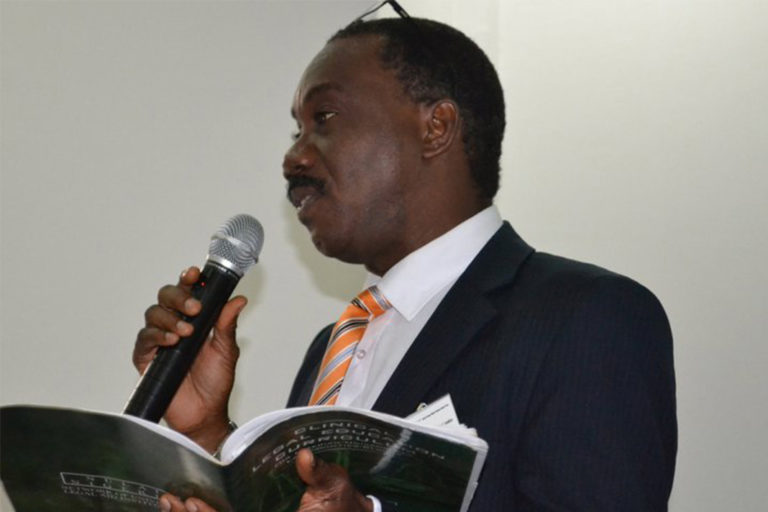
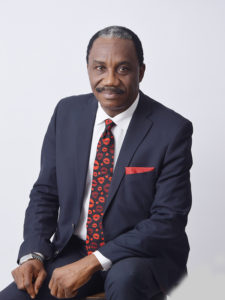
Professor Ernest Maduabuchi Ojukwu, a man, close associates call different names, “Ernest“, “Teacher“, “Prof.”, “the father of clinical legal education in Nigeria“, and the Gbaonwa-Gbaonwa Agbaonelu, of Ahaba Imenyi, Isuikwuato Local Government Area of Abia State, was born on September 23, 1960 and hails from Ahaba Imenyi in Isuikwuato Local Government of Abia State in South East Nigeria. He attended the Methodist College Uzuakoli and Government College Umuahia. He also attended Obafemi Awolowo University Ile-Ife where he received the Bachelor of Laws and Master of Laws Degrees in 1983 and 1987 respectively.

Professor Ojukwu is the immediate past Deputy Director-General and Head of Campus of the Nigerian Law School, Augustine Nnamani Campus, Agbani Enugu. Before his appointment at the Nigerian Law School, he was Associate Professor and Dean Faculty of Law, Abia State University, Uturu from 1995-2001. He is also the President of the Network of University Legal Aid Institutions (NULAI Nigeria), the platform through which he has continued to achieve his dreams of promoting clinical legal & justice education and reform of legal education in Nigeria. He is Partner at the Law Firm of OFY Lawyers and Professor of Law at Madonna University.

Professor Ojukwu began his career in 1985 when he simultaneously joined the services of Abia State University as an Assistant Lecturer and began to practice Law in the chambers of Chief G. N. Atulomah. In 1988, he left to establish with his friends, a Law firm named Eleuthera Chambers. He rose to the position of Dean of the Faculty of Law in Abia State University where he served from 1995-2001.

Professor Ojukwu has also been a very active member of the Nigerian Bar Association, with a tremendous record of service at the local, regional and national levels, and has at one time or the other held the following positions:

Chairman NBA Aba Branch 1997 – 1999; Secretary NBA Aba branch 1992-93; Chairman NBA Law Reform Committee 2003 to 2004; Chairman NBA Academic Forum 2006 to 2010 & 2012-2014; Chairman NBA Editorial Committee 2006-2008; Chairman NBA Legal Education Committee 2006-2008; Chairman NBA Strategic Plan Working Group 2012; Project Director NBA Institute of Continuing Legal Education (Set up the Institute of Continuing Legal Education and commenced the MCLE as the Pioneer Director) 2006 to 2010; and 2012- 2014; Alternate Chairman 2003 NBA Annual Conference Planning Committee; Alternate Chairman/Editor-in-Chief, Editorial Board Nigerian Bar Journal, October 2002 to 2004; Alternate Chairman NBA Summit on the future of legal education in Nigeria 2006; Member NBA Special National Committee on Abuse of Executive, Legislative and Judicial powers, 1998 to 2000; Member, Joint working committee of the NBA & CLEAN on continuing legal education for practicing members of the legal profession August 1999 to 2000; Sole Member, NBA Standing Sub Committee to investigate complaints against legal practitioners October 1999;  Member NBA Legal Education Committee, 2002 to 2004; Member Steering Committee of HURILAWS-NBA National Action Plan for justice sector reform in Nigeria, 2002; Member 2002 NBA Annual Conference Planning Committee; Member NBA Practicing fee, stamp and seal committee, Jan 2003 to 2004; Member NBA Committee on the state of the NBA, March 2005; Member NBA Special Committee on the Review of the Rules of Professional Conduct 2006/07; Member NBA Working Group on the Review of the Legal Practitioners’ Act and Council of Legal Education Act, 2011; and Pioneer Chairman/Founder NBA Eastern Bar Forum (EBF) 2004-2011.

He has also been member of many other NBA Committees since 1999 and in the various positions he held and committees he served, he has exciting achievements to present.

As Chairman of NBA Law Reform Committee he produced a new Legal Practitioners Act in 2004 under President Wole Olanipekun, SAN.

In 2006, the NBA under President Olisa Agbakoba SAN requested an amendment in place of a completely new Act and Professor Ojukwu submitted an amended Legal Practitioners Act which then was submitted to the National Assembly.

In 2011, the NBA under President JB Daudu SAN set up a new Committee to draft a new Legal Practitioners Act. Professor Ojukwuproduced a new draft for the Committee and that draft is currently pending before the National Assembly today.

In addition to the Legal Practitioners Act, Professor Ojukwu also submitted to the Bar draft bills on Legal Education and Legal Services Commission. This is also presently before the National Assembly.

Professor Ojukwu is currently a member of the recently inaugurated NBA LEGAL PROFESSION REGULATION REVIEW COMMITTEE and the Chairman of its sub-committee- THE FUTURE OF THE LEGAL PROFESSION.

Ernest OjukwuProfessor Ojukwu has published extensively. He is co-author of “Introduction to Civil Procedure”, a quality and leading material on Civil Litigation for Law School Students in Nigeria as well Legal Practitioners, Editor-in-Chief of the “African Journal of Clinical Legal Education and Access to Justice“, “Abia State University Law Journal” (1995-2000), Nigerian Law and Practice Journal (2006-2013), & Editor-In-Chief “Nigerian Bar Journal” (2002-2004 & 2006-2008). He is also a leading vanguard in pioneering the development of clinical legal education in Nigeria and is the President of the Network of University Legal Aid Institutions (NULAI Nigeria) which serves to promote clinical legal education and reform of legal education in Nigeria.

He is Principal Co-Author of the following clinical Legal Education books: “Clinical Legal Education: Curriculum Lessons & Materials”, Handbook on Prison Pre-Trial Detainee Law Clinic”, “Manual on Prison Pre-Trial Detainee Law Clinic”, “Impact Assessment of Clinical Legal Education in Nigeria”, “Externship Students Handbook”, and “Externship Handbook for Supervisors”. He is the National Representative of Nigeria in the Brown-Morsten International Client Consultation Competition.

Professor Ojukwu was conferred with the rank of Senior Advocate of Nigeria, the highest professional rank available for legal practitioners in Nigeria in 2014. He was sworn in on Monday 22nd September 2014, by the Chief Justice of Nigeria, Honourable Justice Aloma Mariam Mukhtar.

Professor Ojukwu interest as a scholar includes the subjects of Continuing Legal Education, Civil Litigation and Access to Justice.

He drafted the Nigerian Bar Association CLE Rules and set up the Institute of Continuing Legal education in 2007. He has also continued to play a very active role in the professional activities of the Nigerian Bar Association where he once served as the Chairman, Aba Branch of the Association, Chair of the Law Reform Committee, the Academic Forum and Legal Education Committee.

Professor Ojukwu has conducted many training programmes and workshops for the practicing lawyers, law teachers and law students. He has attended and presented papers at several International conferences on legal education such as the Global Alliance for Justice

Prof Ernest Ojukwu SAn

Education (GAJE)  conferences at Cordoba Argentina 2006, Philippines 2008, Valencia Spain 2011 and New Delhi India 2013; speaker at the IBA’s (International Bar Association)  conference at Chicago 2006 and Boston 2013; the Journal of Clinical Legal Education (IJCLE) conference Perth Australia 2009 and Griffiths 2013; Externship 6 Conference Boston 2012; Harvard Law School Global Legal Education Forum 2012; and Association of American Law Schools (AALS) Clinical Legal Education Conference Puerto Rico 2013.

Professor Ojukwu is a humble, unassuming, distinguished living legend and icon of the legal profession. He represents many things to many people-both friends and foe, within and outside Nigeria, but everyone agrees that he is a teacher, mentor, renowned advocate, great thinker, eminent scholar, administrator, and everything hard work and integrity personified.

Professor Ojukwu is married to Hon Justice Ijeoma Ojukwu of the Federal High Court and the marriage is blessed with five children.

The Global Face of the Ethical Lawyer

0

Legal professionals from around the world talk about ethics.

Over three days in July, Fordham’s Stein Center for Law and Ethics welcomed prominent academics, practicing lawyers, and regulators for the seventh International Legal Ethics Conference. The event, spearheaded by Stein Center Director Bruce Green and Associate Director Sherri Levine, featured more than 80 programs on a range of topics including access to justice, international rule of law, challenges to judicial integrity, and professional regulation.

More than 400 participants from 60 countries attended.

Here, nine of them speak about their experiences.


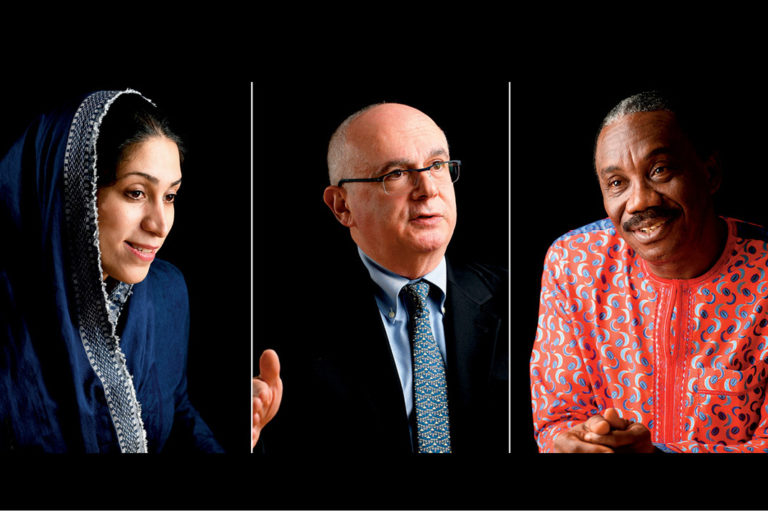
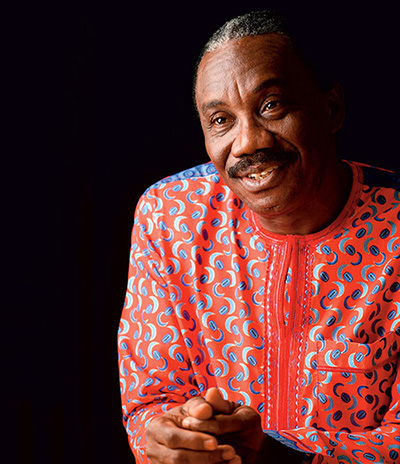
Ernest Ojukwu  |  Nigeria

With the many problems concerning legal ethics in his home country of Nigeria, it was not easy for Ojukwu to find sponsorship to attend ILEC.

“When discussing problems facing the nation, people identify ethics, corruption, and lack of discipline as challenges,” he said. “But when you ask for action, these problems are taken off the table. It is difficult to find institutions that have enough funding to fight the problems of ethics and lack of discipline.”

Ojukwu has been heavily involved with integrating legal ethics into Nigerian culture, especially at universities throughout the country. He is also very active in the Nigerian Bar Association and is currently focusing on access-to-justice issues, especially in litigation.Ernest Ojukwu
“I am very interested in building a culture of ethics in my home country, particularly at the educational level. So I am excited to see and hear from colleagues who have taught ethics and to learn how they have integrated ethics into their cultures.”

At ILEC, Ojukwu spoke about integrating the concept of legal ethics at the academic level. His panel, “Actions Speak Louder Than Words: The Ethical Law School,” discussed the challenges various institutions from around the world face with improving legal ethics training.

“The best forum to talk about legal ethics is at the educational level, particularly starting when students are at a younger age,” he said.

Ojukwu has been practicing law since 1984 and is a professor of law in Nigeria. He also serves as president of the Network of University Legal Aid Institutions (NULAI).

“The NULAI in Nigeria has helped about 19 law faculties establish law clinics, for which we were able to develop an ethics curriculum and integrate into the mainstream of law school clinical courses,” he said.

Ojukwu and his fellow ILEC panelists encouraged participants to reflect on what is right and wrong in regard to legal ethics, as well as to discuss measures that can be taken to train law students to become more ethical lawyers, in spite of the many challenges imposed by society. He noted that the conference’s diversity is integral to facilitating such changes.

“The diversity of participants at the conference is very important. Ethics is an international problem. Because cultures differ, it is fundamental to understand how each country is grappling with the challenges of ethics. With that kind of diversity we can learn a lot from each other.”

Ahmed Al-Hawamdeh |  Jordan

Al-Hawamdeh, an associate professor of corporate law at Jerash University, traveled to ILEC so that he could learn from other countries’ experiences and implement better practices in Jordan.

“I expect to get a feel for what’s going on around the world and hopefully find solutions to problems that we encounter back home in Jordan,” he said. “Jerash University is trying to better prepare students for the market and not leaving it up to the chance of them having good training after they graduate. We really want to make sure that our students are acquiring the skills they need.”
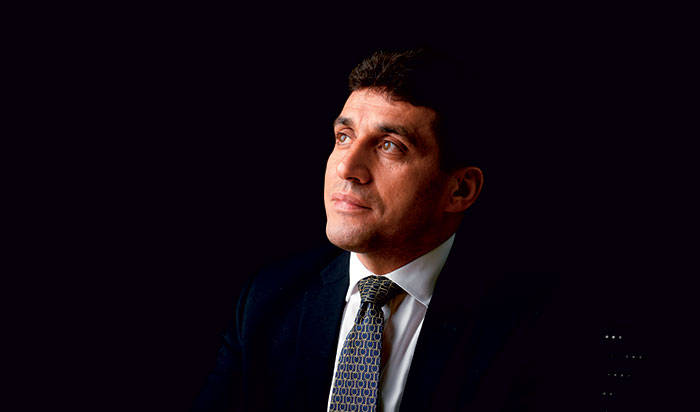
Ahmed Al-Hawamdeh

Since legal ethics is not a focus of the curriculum at Jerash (a relatively new university only 25 years old, with approximately 300 students), Al-Hawamdeh had a difficult time finding sponsorship to attend ILEC. Fortunately, he was one of about 40 participants who received a travel subsidy disbursed by Fordham Law.

Speaking on the same ethics-in-legal-education panel as Ojukwu, Al-Hawamdeh believes ILEC provides an invaluable opportunity for meeting people from all parts of the world.

“The conference is a great chance to talk with people and hear their different perspectives,” he said. “Based on others’ experiences, I will hopefully learn something that I can take back home to Jordan.”

Al-Hawamdeh earned his undergraduate degree in his home country, later studied in Scotland at the University of Aberdeen, and then obtained a Ph.D. in England. Since his return to the Middle East, he has worked tirelessly to reform Jordan’s system of legal education, including involving students more in issues related to helping the underprivileged or those who don’t have access to justice.

He feels the international range of academics at ILEC is the key for improving legal ethics, because it is a venue where everyone can share their experiences and solutions.

“In order to prepare students on ethical issues, you need to have common solutions,” he said. “What you learn from looking at others’ experiences and how they manage to overcome the obstacles they face gives you strength to carry on and believe that something will come of it.”

Olga Churakova  |  Kyrgyz Republic

Access to legal aid is a global concern. Defense lawyers, who serve as protectors of the human right to due process and a fair trial, face challenges in every country. Without access to effective legal counseling, individuals are at risk of being detained arbitrarily or illegally—or worse, they may even be wrongfully convicted or subject to torture.

Motivated to right these wrongs, Churakova directs the Advocates’ Training Center in the Kyrgyz Republic to improve the professional knowledge of advocates so that they can provide the highest level of quality legal service to the country’s citizens. By traveling to ILEC, Churakova hoped to learn new ways in which she could increase opportunities for advocates and spread awareness of legal ethics norms in her country.
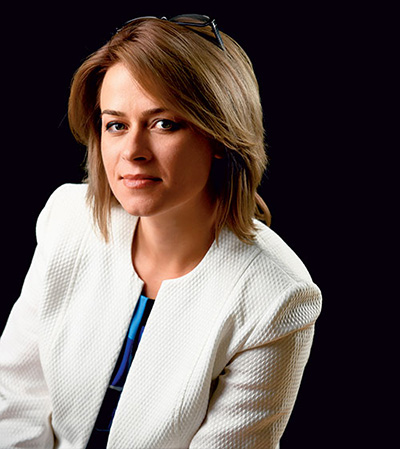
Olga Churakova“With participants from more than 60 countries present at the conference, there is a very interesting opportunity to learn everything about legal ethics throughout the world and to improve the systems of our countries where we are living and working,” Churakova said.

In 2014, the Kyrgyz Republic developed a new legal ethics code for advocates, which paved the way for the inclusion of ethics training in basic courses. Churakova noted that one of the biggest challenges surrounding legal ethics in her country is advocates having to deal with conflicts of interest while remaining ethical.

“I think that every advocate has struggled with some difficult ethical question in their professional career, but oftentimes there is no one for them to consult with on what to do in such a situation,” she said.

At ILEC, Churakova spoke on the “Building Defense Bar Capacity to Ensure Equality of Arms” panel. She said that advocates in the Kyrgyz Republic are not generally held in the same regard as judges and prosecutors.

“The advokatura [the bar]has to be put on the same level as the prosecutor’s office in order to protect human rights. We are trying to disseminate our new ethics code and improve advocates’ training,” she said.

The Advocates’ Training Center intends to continue the process of improving legal ethics training of advocates and lawyers of the country through teaching sessions.

“Networking at the conference was extremely important to discussing legal ethics issues. It was a great opportunity to meet the specialists and experts
from around the world,” Churakova said. “I’m very glad to have been invited. I would have never imagined I could have attended such a conference. It is exciting to learn the experiences of other countries.”

Suphamat “Bee” Phonphra and Nattakan “Ann” Chomputhong |  Thailand

Jetlagged but excited for their first visit to the United States to attend ILEC, Phonphra and Chomputhong came as representatives of Bridges Across Borders Southeast Asia Community Legal Education Initiative (BABSEACLE), an international organization working to strengthen access to justice, legal ethics education, and community empowerment.

At the core of BABSEACLE’s mission is the belief that access to justice is an ethical responsibility. Through clinical legal education, the organization aims to foster community service–minded lawyers and pro bono advocates to help extend legal assistance in often marginalized communities.

SuphamatPhonphraNattakanChomputhong

Phonphra, an access-to-justice initiative coordinator, and Chomputhong, a legal trainer and legal ethics and professional responsibility initiative coordinator, were drawn to work with BABSEACLE because they saw firsthand the lack of adequate legal ethics education in Thai universities, a situation that is only recently beginning to change.

“When I was a student, the lectures did not inspire me about how to be a good lawyer,” said Phonphra. “I didn’t know until I had worked for four or five years, and now I understand more.”

“My university was a bit different,” noted Chomputhong. “When I was a student we had legal ethics, but just one credit, so we did not learn much.”

Now both women train lawyers, students, and educators throughout Asia, using an interactive and practical curriculum for teaching legal ethics created by BABSEACLE in collaboration with international law firms, teachers, and government partners.

The BABSEACLE curriculum provides a needed core structure of legal ethics education, which can be adapted to different legal systems depending on the country in which it is taught.

So far the curriculum has been implemented in several Southeast Asian countries, including Thailand, Vietnam, Laos, Cambodia, and Myanmar.

In their ILEC session, Phonphra, Chomputhong, and two BABSEACLE colleagues modeled their interactive approach to teaching the curriculum, which uses group work and role-playing to have students engage with real ethical issues they would encounter in practicing law.

Though both women acknowledge that there is still much work to do to spread legal ethics education throughout Asia, they have seen progress since working with BABSEACLE.

“Through the clinical legal education program, not just lawyers but also students who work in the clinics provide free legal advice and also do community teaching,” said Chomputhong.

Going forward, both women hope to encourage more regional people to get involved in their movement and also further cultivate the interchange of ideas and resources with international lawyers and educators, as they did at ILEC.

“We would welcome more suggestions for effective methods or tools that we can use to improve legal ethics teaching in Asia,” said Chomputhong. Referring specifically to lawyers and educators from non-Southeast Asian countries, she continued, “They are welcome to come and assist in any training provided, any materials they can share.”

Phonphra seconded Chomputhong’s call for further international collaboration. “Contact us!” she said with a broad smile.

Zoha Savadkouhifar  |  Iran, Pakistan

When Savadkouhifar was a legal adviser and researcher in Iran, she had the opportunity to evaluate the state of legal ethics in the country by working with different judiciary departments and academic programs such as legal clinics and also studying the larger context of Iranian constitutional law.

She recognizes that Iranian constitutional law and other legislative and administrative laws already provide structures and procedures to oversee and regulate the behavior of lawyers and judges, and she understands that constitutional law in Iran incorporates Islamic law, which sets forth specific rules for the independence and impartiality of judges. However, she believes that laws alone cannot ensure justice if lawyers and judges are not educated in how ethics should be applied in the many facets of their professional practice.

Zoha Savadkouhifar“We all know that when the person is not trained, whatever the law is won’t work,” she said.

For Savadkouhifar, currently a Ph.D. candidate at Shaheed Zulfiqar Ali Bhutto University of Law in Pakistan, what is needed in Iran is a stronger commitment to legal ethics education in the country’s law schools.

She has seen the consequences of inadequate training; she once confronted a family court judge who was compelling a woman to stay in a marriage because the judge did not believe the behavior of the husband was harsh enough to grant the divorce the woman was seeking.

“I told him, ‘This woman came to your court to access justice. You are violating her more than her husband is,’” she said.

In the past few years, Savadkouhifar has seen some progress in Iran, including the introduction of legal ethics courses and legal clinics in universities; workshops for judges, police officers, and court workers; and discussions of legal ethics by bar associations.

“What I can say is that I am hopeful for the next generation,” she said.

One area in which she has passionately applied her expertise to bring about change is juvenile justice, where important advancements have been made recently. Savadkouhifar has played key roles in some Iranian national projects, including “Model Law on Management of Juvenile Correctional Departments” and “Developmental Crime Prevention through Schools for Children at Risk,” now implemented in three pilot schools.

Savadkouhifar, whose husband is from Pakistan, where they now live, is currently a member of the Pakistan bar association. At ILEC she spoke on a panel titled “Legal Ethics and Legal Education in Two Islamic Republic Countries,” and she is eager to continue learning about legal ethics in international and comparative contexts. She is now an LL.M. student at Penn State Law and will continue her Ph.D. in Pakistan next summer.

“If we really want to do such things as policymaking in my country, nowadays we cannot do anything if we don’t know what is going on in the international environment.”

Martin Bohmer  |  Argentina

“In Argentina, the joke is that legal ethics is optional,” said Bohmer, opening his ILEC presentation as part of a panel on the state of legal ethics in Latin America.

Though the remark was met with genial laughter by the assembled panelists and audience members, it pointed to a serious reality of legal education inMartin Bohmer Argentina.

“Mostly there are no courses on legal ethics,” said Bohmer. “And when we do teach it, it’s an optional subject in the law school.”

As a professor of legal theory at Universidad de Buenos Aires Law School, where his own legal ethics course is optional, Bohmer has often had to convince his students that the subject is not a trivial matter.

“So the first thing I found that I needed to do in the classroom was to create a sort of gravitas in the atmosphere—to put things in a more dramatic light,” he said.

In the classroom, Bohmer tries to awaken students to the life-altering impact their work as lawyers may have on others.

“You are going to take away children from someone, you are going to put somebody in prison, you are going to destroy relationships, you are going to start a bankruptcy of a corporation,” he tells them.

He hopes to cultivate a reflective capacity within his students that will help them take proper actions as lawyers.

Bohmer also wants his students to see the way legal ethics are connected to a much broader national context and serve as the foundation for the rule of law in Argentina as a whole. His point is that if lawyers fail to act in good faith, are dishonest or unscrupulous, then codes of procedure cannot work as they should.

“If you cannot make a code of procedure work, then you cannot make the civil code, the criminal code, the law work,” he said. “And if you cannot make the law work, you cannot make the constitution work.”

His students’ attitudes change, he said, “once they realize that we are dealing with legal ethics not just to be nice but to fulfill the role of the lawyer in a constitutional democracy.”

Currently, Bohmer is serving as national director in the Ministry of Justice of Argentina, where he is assisting in the first-ever process of accreditation of law schools. As part of this project, law schools across Argentina have recognized the need to include legal ethics courses, though a lack of qualified faculty and necessary teaching materials often hinders the achievement of this goal.

“So my job now is to finance the development of materials to teach, and then with those materials to train the trainers who will teach,” said Bohmer.

Russell Pearce   |   New York

Hip hop rhythms from the acclaimed Broadway musical Hamilton played in the background as participants assembled for an ILEC session discussing relational perspectives on ethics and the legal profession, the first of its kind at an international legal ethics conference. 

As the music faded out, Pearce, the session’s moderator, explained the musical’s connection to the subject at hand.

“Hamilton was, after all—whatever you think of his politics—a person who valued the role of relationships in politics,” he said.

RussellPearce

A professor at Fordham Law since 1990, Pearce has focused on relational theory as an important part of his examination of what creates a just legal system and the role that lawyers play in providing justice in society.

His work on relational theory questions the widely held “atomistic” view prevalent in law, business, and politics today, which sees individuals and organizations operating separately from each other.

“An atomistic actor in any of these areas thinks, ‘What can I get away with?’” said Pearce.

According to him, the atomistic actor “is the measure of self-interest, because you are separate and your self-interest doesn’t have to take into account your friend, your neighbor, your colleagues, or your community.”

For Pearce, the consequences of this mindset can have damaging consequences in our society, including “incivility in politics, short-term thinking in business, and hired-gun approaches in law,” he said.

In reality, “it’s a myth that anyone or any organization is atomistic,” he said.

“Every successful lawyer, every successful business person recognizes at some level that their success depends on their relationships.”

Debunking the atomistic myth is necessary to fight narrow self-interest, he said, and on a broader level, combat the problems of income inequality and gender and racial injustice.

Pearce, who is Jewish, also focuses part of his work on religion and law, cultivating among lawyers who are religious a dialogue about how faith can inform legal practice and education. He serves as the faculty director of Fordham’s Institute on Religion, Law, and Lawyer’s Work.

His broad interests include the study of the ways that new technologies, such as online legal services company Legal Zoom, are changing the profession and the market. Though these technologies can provide legal assistance to those who perhaps could not otherwise afford it, they are currently unregulated in the United States.

“As we better understand where technology is going, we’ll have a better understanding of how to regulate in the interests of protecting consumers, protecting society, and providing broad access to justice,” he said.

Xiaobing Liu   |   China

Having studied law in the United States and China, Liu has a solid understanding of the differences in legal ethics education in the two countries.

In his view, China is making progress but still lags behind the United States and other western countries in instilling legal ethics in students and addressing problems with conflicts of interest, breaches of client privacy, and other forms of misconduct on the part of lawyers.Xiaobing Liu

“In China the economy has grown up, but rule of law is backward, so there is a difference,” he said. “In the United States and most western countries the rules are very detailed; in China they are far from detailed.”

As a professor at China University of Political Science and Law, he is doing his part to improve the situation as the director of the only university department in the country devoted to the study of legal ethics.

Liu and his faculty of 11 professors are part of a movement to professionalize the study of law in China, where a student does not need to attend law school before taking the bar exam.

In his ILEC talk, Liu outlined recent legal ethics reforms set forth by the Chinese central government, and also the challenges faced in their implementation, including inconsistent standards among government offices, underdeveloped educational programs, and a lack of qualified faculty.

“In China the situation is getting better, but we still have a lot of problems,” he said. “That’s why we call it a crisis of legal ethics because many lawyers do not comply.”

To illustrate his point, Liu gave the example of the much-publicized case involving Tianyi Li, the teenage son of a Chinese general convicted of rape in 2013. In the trial, Li’s lawyers attacked the credibility of the victim, described her as sexually promiscuous, and made her medical records public.

Liu himself is committed to doing pro bono work and serving in the community. “I devote my time to those who need legal aid,” he said. “In my university I also have a legal clinic. I lead, guide, and instruct the students to help those who are poor.”

Though Liu feels optimistic about the future potential of legal practice in China, he also knows real change won’t happen overnight.

“Of course it takes time to implant the idea of legal ethics in every lawyer’s mind,” he said.

Story by Samantha Mathewson and Nina Heidig, photographs by Chris Taggart

FG Inaugurates High-Powered Committee To Review, Update Archaic Nigerian Laws Within 6 Months

0

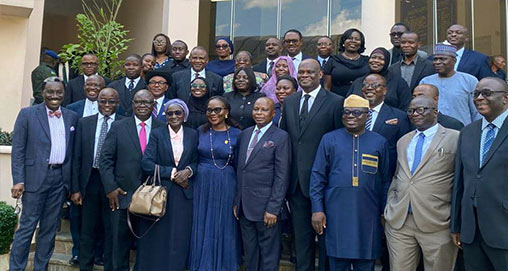
The federal government on Thursday in Abuja inaugurated a committee of high-powered law experts from various fields to review, update and consolidate archaic Nigerian laws within six months.

The law review and update are said to be part of the ongoing efforts of President Bola Ahmed Tinubu to promote the rule of law and access to justice in line with the policy objectives of enabling socio-economic growth and advancing legal reforms.

Inaugurating the Committee on behalf of the federal government, the Attorney General of the Federation, AGF and Minister of Justice, Prince Lateef Fagbemi SAN, asked the committee members to be meticulous in the execution of the task placed before them.

Fagbemi challenged the law experts to focus on the identification of outdated laws which according to him, are not in line with contemporary needs and values, as well as harmonization of conflicting laws, to ensure uniformity and consistency.

He said “I would like to inform you all that this is a project which is particularly dear to my heart, and I have always been concerned about our seeming inability to update the Laws of the Federation (LFN) since 2004, to enable clarity, predictability, consistency and uniformity in our body of laws.

“You are all aware that the general purpose of law is to protect public interest and regulate human behaviour and interactions between corporate entities.

“The law is constantly dynamic and evolving, hence, there is a need for continuous review or reform of our body of laws to address contemporary socio-economic developments, resolve conflicting and obsolete provisions with the ultimate aim of improving the administration of justice and promotion of rule of law.

“As you are aware, the review, update and consolidation of the Laws of the Federation, 2004 is long overdue to reflect and consolidate legislative developments (inclusive of repeals, amendments and enactments) from 2004 till date, in furtherance of the law development mandate of the Federal Ministry of Justice.

“The expected key areas of focus for the Committee in the instant exercise are identification of outdated laws which are not in line with contemporary needs and values, as well as harmonization of conflicting laws, to ensure uniformity and consistency.

“This is with a view to attracting socio-economic growth and investment, promoting efficiency and adapting to technological advancements.

“This Committee has been deliberately set up with individuals with vast professional experience and technical expertise in various aspects of the justice sector.

“I realize that there is a lot of work to be done and I would like to thank you all for accepting the call to serve our nation in this capacity.

“Let me particularly express gratitude to the leadership of the National Assembly, the Nigeria Law Reform Commission and the Nigerian Institute for Advanced Legal Studies, for also supporting this initiative.

“Please be assured that the Federal Ministry of Justice will always be available to provide institutional support and assistance where required, to ensure that the Committee achieves its mandate.

The Committee, which is chaired by Olawale Fapohunda, SAN, and co-chaired by the Chairman of the Nigerian Law Reform Commission, Professor Jummai Audi, includes Prof Ernest Ojukwu SAN (Teacher), ST Hon SAN, Tunde Fagbohun SAN, Prof Deji Adekunle SAN, Justice Ajileye (rtd), Prof Peter Akpe SAN, Dr Balkisu Saidu and a law school lecturer, Sylvester Udemezue, is charged with the following Terms of Reference:

“Coordinate the collection, collation and compilation of LFN up to 2024, Work with relevant Government Agencies in harmonizing the Laws of the Federation up to 2024 and to cross-check, edit and proofread all the legislations to be collected.

“Identify all Legislations not included in the 2004 edition of the Laws of the Federation and update the same, identify outdated or redundant laws in the current Laws of the Federation that need repeal and merge laws addressing related matters to eliminate redundancy.

They are also to prepare a comprehensive report of findings to the AGF thereafter and perform and undertake any lawful assignment incidental thereto.

“The time frame for completion of this national assignment shall be 6 months from the date of this inauguration. I enjoin the Committee to make best efforts to deliver within the stated timeline.

The AGF also charged the Committee to work in synergy and exhibit patriotism, in the overall interest of the nation and expressed optimism to receive the report and copies of the draft volumes of Laws of the Federation 2024 in line with the wish of the federal government.

FG Inaugurates Committee on Education Roadmap

0

The Federal Government through the Federal Ministry of Education, has inaugurated an eight-man committee to drive and actualize set objectives in the education sector. Inaugurating the Committee, last week in Abuja, the Honourable Minister of Education, Professor Tahir Mamman tasked the members to develop ways that would help the Ministry turn around the fortunes of the country.

He said that the event marked a pivotal moment in the nation’s pursuit of educational excellence and societal development, while highlighting the urgency of their mission, he emphasised the need for clear direction to transform Nigeria’s fortunes.

The Minister inform the members of the Committee that “I must confess that your assignment is not going to be an easy one because Nigerians are looking forward to the administration of His Excellency, President Bola Ahmed Tinubu to do a quick turn-around in all sectors of the economy, with education being the fulcrum to galvanise the needed changes to make Nigeria hold her head high in the comity of Nations.

“Mr. President has clearly laid out his vision for his administration and it is anchored on “improving the lives of Nigerians in a manner that not just reflects our humanity but encourages compassion towards one another and duly rewards our collective efforts to resolve the social ills that seek to divide us”.

“On education specifically, our president has declared his commitment and as a priority, among other missions, to see about 10.5 Million Nigerian Out of School Children retrained with skills that will make them stand on their own. We will, therefore, need a clear road map and framework that will guide the ministry achieve these goals.

“To achieve this vision, we must necessarily harness our human resources. But before we harness our human resources, we need to be sure of what we need to do to fill in the gaps that have, over the years, inexplicably pulled us back,” he said.

Professor Maman further highlighted some issues that the Committee would need to look at, saying it was important that the curriculum, from basic to tertiary level meet the demands of the current realities and needs of the society.He also charged them to occupy their thoughts with the issues of Financial Autonomy in Tertiary Institutions, access and equity, research and innovation as well as the government-industry-academic and the global competitiveness of the educational system should not escape their scrutiny.

“One thing I must not fail to add is that we must have an education system that embraces technology and move into a digital future where our education responds to the demands of the society. We need to move away from education for its sake but to education for the development not only of the individual but most importantly for the society we live.”

Responding, the chairman of the committee, Dr Nuru Yakubu who was ably represented by Professor Ernest Ojukwu pledged to duly take up the responsibility and undertake the assignment meticulously in the best interest of education sector and the country as a whole. He, on behalf of the members of the Committee, thanked the Federal Government, through the Honourable Minister of Education for finding them worthy to deliver the daunting task.

Members of the Committee included; Dr. Nuru Yakubu, Chairman, Prof. Ernest Ojukwu, member, Prof. Sa’ad Umar, member, Shulamite Paul (Ms), member, Dr. Garba Ibrahim, member, Hajia Hindatu Abdullahi, member, Prof. Ismail Junaidu, member and Mr. Joseph Achede, Secretary.

Madu-abu-chi – Ernest Ojukwu and Destiny Foretold –By Chidi Anselm Odinkalu

0

In the cosmology of African communities, naming rituals are very important because the name tells a story and predicts destiny. When on 23 September 1960, Helen Nmemahialuka (Nmema) Ikeanyionwu gave birth to her son, she called him “Madu-abu-chi” – no human is God.

Nearly two and a half years before, on 26 April, 1958, Nmema got wedded to Robert Nwokeocha Ojukwu Ikeanyionwu at the grand old age of 25. Born, Mmema Atulomah, she was a teacher from Umuahia in the then Eastern Region (now Abia State) working in Oturkpo in the then Northern Region (now Benue State), the daughter of a Methodist missionary, who had the privilege of early access to education; Robert was a Produce Inspector, servant expert in the aggregation and standardization of various primary products for export, including the famous peanut pyramids of Kano. Their mutual journey down the aisle began with a chance meeting the previous year on a train journey to their respective work stations in northern Nigeria.

At 25, the neighbourhood whisper then was that Nmema was well past the age of marriage and her education was to blame. Her first pregnancy miscarried. When she lost the child from her second pregnancy shortly after birth, another statistic in child mortality, the frenzy of naysaying from the neighbourhood shamans took on a life of its own. Her answer to them was in the name she gave to her son. Madu-abu-chi was at once an affirmation of her faith, a prayer to her Creator and an embodiment of her hopes for him. Upon being baptized in the Methodist faith, the child was given the name Ernest. In time, Madu-abu-chi would also come to define the message and mission of the child, “earnest” became his method. Today, we know him as Professor Maduabuchi Ernest Ojukwu, Senior Advocate of Nigeria (SAN) and the father of clinical legal education in Nigeria.

Maduabuchi unlocked fertile fortunes for Nmema, who would go on to have nine children, sadly losing two. She was a teacher among teachers. She ran schools as head-teacher and was a fearsome political organizer and long-time executive member of the Nigerian Union of Teachers (NUT), in the old Imo State in south-eastern Nigeria. In that role, around 1982, she survived an assassination attempt, miraculously escaping with the graze of a bullet to her forehead, in Umuahia, current capital of Abia State. Retiring from the public service as a supervisor of schools, Nmema plunged into livelihood advocacy for women and became a proprietor of a genre-defining El-Shaddai Foundation Daycare-Nursery-Primary School, Ahaba, in Isuikwuato, Abia State, her vision was to enhance the educational status of the rural child, with the motto, “Shine that others may see”. When she died 12 years ago, Nmema bequeathed the management of the children in the school – all 350 of them – as a trust to a team with one message: Madu-abu-chi. The Chair of the trustees was her Maduabuchi. Message and mission had become one.

Today, Maduabuchi, a third generation teacher on his maternal side, lives out his natal mission, enabling children in the entire educational value chain from nursery to graduate school in Nigeria and beyond to fulfill their dreams and realise their ambitions, safe in the knowledge that no human is god over them.

I was a witness to its beginning. In September, 1985, a young man walked into my undergraduate criminal law class in the then Imo State University in a temporary site in Aba. He carried no notes, no pads and no airs. He knew the Criminal Code like the back of his hand and the relevant texts like he slept with them. He made learning a joy to be part of. He had completed his high school at Government College Umuahia, after a stint at Methodist College Uzuakoli (the high school from which his dad graduated in 1952), before taking a degree in law from Obafemi Awolowo University, Ile-Ife, graduating at the very top of his class in 1983. He was admitted to the Nigerian Bar in 1984, the same year that Mmema retired from the public service, before becoming our teacher from that memorable day in 1985, having joined the staff of the university as an assistant lecturer in 1985, at the end of his compulsory national service programme. Ten years later, at 35, he became Dean of Law at the same faculty, by then known as Abia State University, a position from which he would propel it into one of the top law faculties in the country.

All this while, he was also active in legal practice and in the organized legal profession, becoming chair of the Nigerian Bar Association (NBA) in Aba and later founder of the Eastern Bar Forum. His academic and legal practice careers met at the confluence of the Nigerian Law School, where he became Deputy Director-General and head of the Enugu Campus for 12 years from 2001. It was from there that he founded what would become the Network of University Legal Aid Institutions (NULAI), in 2004, in a collaboration with Isa Hayatou Ciroma and Yemi Akinseye George, becoming its president. All of them are incidentally now law professors and SANs, confirming the point that a professional trajectory does not have to be predictable.

In the beginning, only four law faculties were willing to act as Guinea Pigs for law clinics in Nigeria: Abia State University, Uturu; Adekunle Ajasin University in Akungba-Akoko, Ondo State; University of Maiduguri; and Federal University, Uyo, Akwa Ibom state. Again, I was a witness at that modest beginning, and, with colleagues from the Open Society Justice Initiative, played a part in facilitating the onset of that journey but the vision belonged to Madu-abu-chi. In 2017, the National Universities Commission, NUC, made law clinics compulsory in all Nigerian law faculties. Today, 43 different university-based law clinics are registered with NULAI and making inestimable contributions to both legal education and justice services delivery across the country.

In a lifetime of investment in Nigeria’s legal profession, Madu-abu-chi engineered mandatory, continuing legal education in the legal profession and, in 2007, ensured the enactment of the current set of Rules of Professional Conduct (RPC) in the Legal Profession in Nigeria. When he was elevated to Silk in 2014, it was an overdue acknowledgement of a life of consequential service to education, the legal profession and public life. Back home in Isuikwuato, he is a traditional chief, known by the appellation of Gbaonwa Gbaonwa Agbonelu of Ahaba Imenyi, and the Ugomba of Imenyi Kingdom in Isuikwuato.

While it is indeed true that madu-abu-chi, it is also the case that no one authors their destiny all by themselves. Every trajectory in life gets the benefit of ancestors and helpers along the way. Maduabuchi has been helped along by Ijeoma, a judge of the Federal High Court of Nigeria who presides over his heart and home and who is also a former student. At 60, he has a lot more to give and, if the past is a foretaste of what is to come, the best may yet still be ahead.

Chidi Anselm Odinkalu, a lawyer, is co-convener of Nigeria Mourns. He writes in his personal capacity

My ‘TorMentor’ at 60: A tribute to Ernest Ojukwu

0

I had heard my lecturers at the law school periodically chant the name ‘Ojukwu’, not always in good light (oversabi somebody things), but the underlining message I got was that there was an exceptional lecturer somewhere at one of the campuses of the law school who stood out and upheld a standard beyond average.

I have availed of the opportunity to finally meet this Man in late 2015. I was called by the faculty officer to avail the external examiner the complete questions for Public International Law which I taught that semester. I went to the boardroom to give the external examiner the questions and tendered apologies for not making the questions available in the envelope after marking.

The external examiner was impressed at the standard of the questions in contrast to my experience and I had to admit that I was mentored by Dr. Udoka Owie before she proceeded to Canada on research leave and that was my first solo effort at drafting law problem questions.

I was subsequently placed on the hot seat. The questions I answered that day did not make a millionaire in cash, but it availed the opportunity to gain insight into assessment, teaching methodology, and share a few stories from his experience as a teacher. I had introduced myself to the external examiner but this gesture was not reciprocated as so I asked for his name and he simply replied “Ernest”. Ernest my cheeky self-replied in question, and I got the response Ernest Ojukwu. I became flustered and stammered and realised that truly only fools rush in where the angels fear to tread. I dared to sit with, jest with, question, and even demand an introduction from the man my lecturers in law school spoke of in awe.

I have had the privilege to co-teach with Professor Ernest Ojukwu since 2016. It has been a love-hate relationship. I call him my ‘TorMentor’ because his standard is beyond average and he will make you conform whether you like it or not.  I recall lamenting to some colleagues that teaching with Prof. has given me sessions of insomnia because the thought of him sitting out my lectures if I have not prepared materials for the class hunts to sleep from my eyes. I have gone through fire in the hands of Professor Ojukwu but I am grateful for the opportunity:
• To understand and promote clinical legal education in Nigeria.
• To set up, be a supervisor and subsequently coordinate a law clinic.
• To initiate social justice and public interest law in Nigeria.
• To learn and deploy interactive teaching methods.
• To change the landscape of clinical legal education by being part of the team to review the clinical legal education curriculum.
• To co-author the Administration of Criminal Justice Pre-trial Manual for Law Clinics.
• To initiate and supervise various social justice and public interest law projects.
• To become a teacher of teachers by facilitating a teacher’s training session at the African Colloquium of Clinical Legal Education.

Ojukwu cares beyond the classroom. He has conducted training for the faculty, the law clinic, availed the supervisors at the law clinic opportunities to attend conferences and teacher training at his expenses, and provided moral and financial supports. (We look forward to those cheques). He is an adviser, supporter, and a father. I had can tell him your challenges and although you might get a few blasting for being silly he will give you sound advice and follow-up to be assured that you are better. I was indisposed for a while and just a few days ago he sent me a message “I am happy U are alive again.” Hardworking, intelligent, highly disciplined, a man of integrity who is not afraid to step on toes. A man who enjoys being challenged and questioned in class; accepts dissenting opinions, by the way, we are still in opposing camps on the debate on whether the evidential burden of proof shifts or not.  A man that will take the fall for you in public but don’t be deceived he will skin you in private. How I dread the caustic side of Prof’s tongue.

Ojukwu is a brand that has changed the landscape of legal education in Nigeria and has not just generated a new breed of lawyers but also birthed a new breed of teachers. At the GAJE conference in Indonesia one of the presenters made a comment, “Ernest is not here today, but a new generation of Ernest is here.’’ I am a change maker because I was ‘TorMentored’ by the cream of the crop in legal education. One life @ 60 that has transformed millions of lives, he has indeed raised leaders and teachers. Diamonds are forever. Happy birthday to the Father of Clinical Legal Education in Nigeria, former deputy director at the Nigerian Law School, president of Network of Universities Legal Aid Institutions, chair of Baze Law Clinic, and my ‘TorMentor,’ Professor Ernest Ojukwu.

•Oke, lecturer, Faculty of Law, Baze University and coordinator, Baze Law Clinic.

Ernest Maduabuchi Ojukwu: The Teacher at 60

0

“Our only hope lies in reforming, reappraising and reorganizing the judicial system not only from the point of appointment of personnel but also to the structural imbalance that affects its independence” — Prof. Ojukwu

Sitting in class waiting for the lecturer and in walks a man, pulling his briefcase, smartly dressed in a suit, with a bow tie and a measured smile. He is the new lecturer.

He introduced himself as Prof. Ernest Ojukwu, Law of Contract lecturer. He summarized what to expect of the course; the mode of teaching, view on examination; what he expected of us as students being hard work, and that all shall be well otherwise, as Prof. Ojukwu told us, ‘you will see me in your nightmares’.

What he did not say, however, was that we would see him in our “daymares” too. His demand for understanding was high; you could not waltz your way with him; he was too deep, most grounded, and too discerning to be swayed by a mere puff. You had to know what you were talking about, and you had to know through study. And in that way, he changed the game to our study of law.

Soon we realized we did not like the feeling of avoidable ignorance we were sure he would point out and which we would have cured if we were more diligent. We took a decision, four of us- we later progressed to about seven – to study so hard, to know it so well that any grey area was understandably pardonable.Our decision meant more time to read Prof. Sagay’s Law of contract, read all materials he gave, google beyond the pages of textbooks, argue possibilities of engagement with the law, and to have answers and questions ready for him. It was not easy. When we gathered for our involuntary study group on Saturdays -Sundays inclusive- we would nag about Prof’s expectations, then get down to read, argue, and complain intermittently, especially when the law gets too knotty for our brains to assimilate at that moment. In due time, we would inevitably express the pleasure that comes from understanding new knowledge.

Those sessions of knowledge discoveries acquainted us with jurists and their reasoning; some we criticized, applauded, and others we were in awe of like the legendary Master of the Rolls- Lord Denning at which point law took a different meaning for me.

We feared and loved him. We hated him for the workload his expectations required; and we loved him more fiercely for the knowledge he impacted in us, in no time, we were studying the Law of Contracts and other courses except for Constitutional Law taught by the formidable Prof. Epiphany Azinge. Prof.Ojukwu was strict yet kind, firm but would enjoy a laugh or two with us, he cared for us but was impartial in his demand for distinction. He seemed to believe through his conduct the words of Justice Oliver Wendell Holmes ” A mind that is stretched by a new experience can never go back to its old dimensions” he, without doubt stretched our minds by knowledge, the knowledge he gave and demanded in return. He is a principled man.

Prof. Ojukwu is an assured man; you could take him on in class without fear. I remember several times I would say “sir, I’d like to challenge your position on this” and he would say without fail “sure!” and I will go for it, he will unambiguously concede where I was right and reaffirm where he was right without condescension. Prof. Ojukwu is both knowledgeable and gracious.

He encouraged performance appraisal of lecturers anonymously from students; he opined, feedback had to be both ways, and the faculty would share appraisal forms to the class. No slacks were allowed. He also patterned the length of his lecture with scientific research, using only the hours of optimal assimilation and nothing more. He brought about the pre-class mode of study which is front-loading students with pending topics to enable them to prepare and attempt prepared questions before each class. Any gap in knowledge often resulted from skipping questions in the pre-class; this you may get away with but not in Prof. Ojukwu’s class. He is uncompromising and thorough.

By the time contract class ended, our study pattern was formed, other courses became beneficiaries of his instilled discipline. I would yet encounter Prof. Ojukwu in the Law of Evidence course (with a repeat pattern of Law of Contract demands), Public Interest and Social Justice Law, and during our Clinical and Moot Court Practice. Every other lecturer knew that our class–especially the study group members- was no pushover. Lecturers took extra time to prepare before coming to lecture us; we were studious, knowledgeable, vocal, and unafraid- frankly, one could not go through Prof’s grill without being these and more. He is top of the range.

I am thankful to have been his student, actually; proud.

As Professor Ernest Maduabuchi Ojukwu (SAN)turns 60 years old today, our legal education has been the best beneficiary of his gifts, sacrifices, generosity of knowledge, and contributions. Reputed as the teacher’s teacher, the possibility of your law teacher being a former student of his is very high. Ojukwu graduated as a lawyer in 1983 from Obafemi Awolowo University Ile-Ife at twenty-three, was called to the Nigerian Bar in 1984 and subsequently earned his Master of Laws Degree in 1987.

He began his career at twenty five when he joined Abia State University as an Assistant Lecturer in 1985, he would become an Associate Professor (1998) and appointed Dean Faculty of Law, Abia State University, Uturu at 35 years (1995- 2001) Deputy Director-General and Head Nigerian Law School, Augustine Nnamani Campus Agbani, Enugu (2001-2013), Professor of Law Madonna University (2014-2016), Adjunct Professor LLM International Commercial Arbitration Nasarawa State University, External Examiner and Professor of Law at Baze University, External Examiner Kenyatta University Nairobi Kenya, Visiting Scholar, Griffith University Law School Socio-Legal Research Center Brisbane, Australia.

Prof. Ojukwu, has led an active career, he concluded his NYSC- Legal Aid Yola (1984-1985), Counsel, Law Firm of GNA Atulomah and Co, Aba (1985- 1988), Partner Ekenna Nwajei Nwauche & Ojukwu Aba(1988- 1992), Partner, Nwonye and Ojukwu, Aba (1992-2001) a Partner – OJUKWU FAOTU & YUSUF (OFY-Lawyers), Aba, and Abuja (2014) and conferred with the rank of Senior Advocate of Nigeria (SAN) at the Supreme Court of Nigeria in 2014.

A pioneer per extraordinaire, he was the Pioneer/Project Director NBA Institute of Continuing Legal Education, 2006-2010, and 2012-2014. He drafted the Nigerian Bar Association Mandatory Continuing Legal Education Rules and Guidelines – that drives the mandatory continuing legal education program for the legal profession – and set up the NBA Institute of Continuing Legal education in 2007. He produced the draft- Rules of Professional Conduct for Legal Practitioners in force today and designed a clinical legal education curriculum for law faculties and led the design and implementation of a new curriculum for Nigerian Law School. Beside the Legal Practitioners Act, Ojukwu also drafted bills on Legal Education and Legal Services Commission. Which is before the National Assembly.

Ojukwu is also the pioneer and advocate- introducing Clinical Legal Education in Nigeria (and West Africa), now established in over 40 Law Clinics in Nigerian Universities and the Nigerian Law School – committed to training public interest lawyers for the advancement of social justice for pre-trial detainees and the underserved population unable to afford legal services. As President, Network of University Legal Aid Institutions (NULAI) Nigeria – the platform through which he has continued to achieve his dreams of promoting clinical legal, justice education and reform of legal education in Nigeria; he has conducted and organized client interviewing and counselling skills competitions for law students for over 12 years in Nigerian universities.

Prof. Ojukwu’s over 35 years passion for teaching is unmistakable – Law teacher at Abia State University for 15 years (1985-2000)–taught Nigerian Legal System, Criminal Law, Business Law, Conflict of Laws and Human Rights Law at the LLB; Comparative Criminal Law and Civil Litigation and ADR at the LLM. 13 years (2001-2014) Law Teacher at the Nigerian Law School where he taught Civil Litigation, Fundamental Rights-the procedure, ADR, Professional Skills, and Ethics. Supervised many LLM dissertations; and conducted many clinical legal education conferences, teacher training, and curriculum development workshops in Nigeria.

A selfless contributor and active member of the Nigerian Bar Association, he has served in various capacities – Secretary, NBA Aba Branch (1992-1993); Chairman NBA Aba Branch (1997-1999); Sole Member NBA Sub Committee to Investigate Complaints Against Legal Practitioners, 1999;

Chairman, NBA Law Reform Committee (2002-2004); Founder, President, NBA Eastern Bar Forum (2004-2011); Chairman, NBA Legal Education Committee (2006-2008); Co-Chair, NBA Editorial Committee (2002-2004); Chairman NBA Editorial Committee–during which ten volumes of the Nigerian Bar Journals were published (2006-2008); Chairman NBA Academic Forum (2003-2004; 2006-2008 & 2012-2014); Co-Chairman, NBA Conference Planning Committee 2003; Alternative Chairman, NBA Summit on the Future of Legal Education in Nigeria, 2006; and Chairman NBA Strategic Plan Working Group 2012. Member,NBA Special Committee (Made up of President Agbakoba SAN, General-Sec Lawal-Raban, SAN, and Prof Ernest Ojukwu SAN) on the Review of Rules of Professional Conduct (2007).

A prolific author of over eight books, including-Legal Education in Nigeria: A Chronicle of Reforms and Transformation under Tahir Mamman,  a Contributing Author, to 2 International books on clinical legal education, (1) The Global Clinical Movement- Educating Lawyers for Social justice (Oxford University Press) edited by Frank S. Bloch; and(2) Rethinking Legal Education Under the Civil and Common Law: A Road Map for Constructive Change, (Routledge) edited by Richard Grimes; and a Co-Author–Clinical Legal Education: Curriculum, Lessons and Materials, 2013; Handbook on Prison Pre-trial Detainee Law Clinic, 2012; Manual on Prison Pre-trial Detainee Law Clinic, Abuja, 2012; Street Law: Child Rights Manual.; Impact Assessment of Clinical Legal Education in Nigeria; and Freedom of Information: Handbook for Law clinics, 2015. He has delivered over 300 papers at conferences and workshops.

Worthy of mention, Prof. Ojukwu is a member of the Nigerian Bar Association, Nigerian Association of Law Teachers (NALT), International Bar Association (IBA), Commonwealth Legal Education Association, President Network of University Legal Aid Institutions (NULAI Nigeria)- An Association with the objectives of development of clinical legal education and legal aid and Global Alliance for Justice Education (GAJE).

In recognition of his contributions to humanity and the legal profession, Ojukwu has been awarded the Merit Award by the Nigerian Bar Association Aba branch “in recognition of years of selfless dedicated and meritorious service to the bar”; the GOLD MERIT Award for outstanding Contribution to Isuikwuato and humanity by the Isuikwuato Traditional Rulers Council. The traditional title of GBAONWA-GBAONWA Agbonelu, by his community Agbonelu Ahaba Imenyi Isuikwuato LGA Abia State. Award of Excellence and Recognition by Agbonelu Autonomous Community, Ahaba Imenyi Isuikwuato LGA Abia State. Nigerian Bar Association Aba branch merit award for outstanding contribution to legal education in Nigeria and the most contribution to the development of the Nigerian Bar Association Aba Branch, by the Nigerian Bar Association Aba branch, to note a few.

Prof. Ojukwu has led an exemplary life of immeasurable value, and history, beyond the law, will be most gracious to him. He has given so much, generations after us will be thankful for his diligence to his work. If he decides to stop his contributions, history will still be overwhelmingly gracious, having lived more life in 60 years than a thousand men.

People with his commitment, talent, and grit are in short supply; he is over and above the legal profession, a treasure.

On this occasion of his 60th birthday, to say “thank you” seem most inadequate for his contribution to my life, even though I have left the formal setting of his classroom; Prof. still follows my progress, supports my strides, motivates me, and commends me when I do well. He is among the foremost people I reach out to for guidance and clarity, and he obliges me all the time and never fails to let me know his expectations for my growth. I am thankful for the privilege of this access and mindful of the rarity of it.

May life rewards his work with the country he longs for, may more successes be his; may the legal profession rise to the standard of his noble expectations, and may we all walk in these footsteps he has so engraved beyond the power of any erasure.

Happy birthday, Prof. Ernest Maduabuchi Ojukwu SAN and sir, thank you for your service.

@FlorenceOzor

Lifelong student

DEMOCRACY DAY: WE ARE CELEBRATING DEMOCRACY FRAUD -Prof Ernest Ojukwu, SAN

We have not done well as a nation with regards to elections and rule of law. Our leaders and politicians have paid lip service to the tenets of democratic principles. There has not been any general elections that has not been hijacked by individuals and groups backed by governments through massive rigging, thuggery and brigandage. The same scenario plays out at party primaries. That culture of stealing and rigging elections has also permeated our other segments of society such as the Nigerian Bar Association at both the National and branch elections.

Many organisations and professional groups have also been enmershed in rigging election as a way of life in Nigeria including elections of students unions. The Nation has not bled so much as it has in terms of failed democracy as we have witnessed especially since 2004 when we made the first effort to conduct a civilian to civilian transition elections. Our electoral umpire has largely colluded with our bandit political leaders and party men to foist on Nigeria a culture of dishonesty and fraud in the electoral process. We can hardly say that the leaders that emerge through these fraudulent elections were chosen by the people. And that is why they have hardly represented our interests. And because the electoral system and processes were stolen as a matter of course, it has been impossible to use democratic platforms provided in the constitution to check the excesses of mis-governance including recall of elected representatives at all levels.

This singular act of electoral banditry has provided the impetus for seriously failed governance on human rights, damaged judiciary, poverty and insecurity. What plays out especially at our State and local government levels are massive corruption and
executive lawlessness. It is a shame that Governance has not worked well in Nigeria since the return to civilian rule in 1999. We can only celebrate the 2020 democracy day as democracy aspirations, dreams and hopes for Nigeria.

Usoro, Ojukwu, Adekoya, Mahmoud, 8 other SANs lead Sanusi’s freedom battle, hearing begins today

0

The deposed Emir of Kano, Muhammadu Sanusi, on Thursday instituted a suit before the Federal High Court in Abuja seeking an order for his release from the post-dethronement detention and confinement.

learnt late on Thursday that former Emir’s preliminary ex parte application seeking an interim order for his release had  been assigned to Justice Anwuli Chikere.

Barring any last-minute development, the judge will hear the ex parte application on Friday, our correspondent learnt.

The Kano  State Governor, Abdullahi Ganduje, on Monday deposed Sanusi because of what the state government called “total disrespect  to lawful instructions from the office of the state government.”

On Monday, the dethroned monarch  was  banished to Loko, a remote location in Nasarawa State. On Tuesday,  he was  relocated  to Awe, where he is currently being detained in a guest house.

But Sanusi’s  team of lawyers led by Lateef Fagbemi (SAN) on Thursday filed a suit marked FHC/ABJ/CS/357/2020 before the Federal High Court in Abuja to challenge his banishment and continued detention in Awe by security agencies.

The respondents to the application are, the Inspector-General of Police, Mohammed Adamu; the Director-General of the Department of State Services, Yusuf Bichi; the Attorney-General of Kano State, Ibrahim Muktar, and the Attorney-General of the Federation, Mr. Abubakar Malami (SAN).

In the application, which is a prelude to the main suit, the deposed monarch  specifically prayed for an interim order for the restoration of his rights to human dignity, personal liberty, freedom of association, and movement around Nigeria, apart from Kano State, pending the hearing and determination of his main suit.

“An interim order of this honourable court releasing the applicant from the detention and or confinement of the respondents and restoring the applicant’s rights to human dignity, personal liberty, freedom of association and movement in Nigeria, (apart from Kano State) pending the hearing and determination of the applicant’s originating summons,” the prayer read in part.

Alleging a breach of their client’s rights provided under sections 34,35, 40, 41 and 46 of the Nigerian Constitution, Sanusi’s legal team comprising 12 Senior Advocates of Nigeria, contended, “the applicant’s fundamental right to life, human dignity, personal liberty and movement are seriously under challenge and continually being breached by the respondents.”

The battery of SANs comprises, Fagbemi;  Prof. Konyinsola Ajayi;  a former President of the Nigerian Bar Association, Abubakar Mahmoud;  Adeniyi Akintola, the incumbent NBA President, Paul Usoro; Ifedayo Adedipe, Dr. Garba Tetengi, Suraj Sa’eda, Funke Aboyade, Nesser Dangiri, Ernest Ojukwu, and H.O. Afolabi.

In addition to the interim order, the lawyers sought an order granting leave to the applicant to serve the order to be issued by the court and the main suit on the four respondents through substituted means.

He prayed for an order permitting him to deliver the processes meant for the IGP to any officer in his office at the police headquarters at Louis Edet House, Garki, Abuja, the ones for the DG DSS to any officer at the DSS headquarters at Aso Drive in Abuja, the ones for the AG of Kano State to any officer at state’s Ministry of Justice, Audu Bako Secretariat, Kano, and the ones for the AGF to any officer at the Federal Ministry of Justice in Abuja.

His grounds for the application are, “The applicant’s originating motion and all other processes were filed on March 12, 2020.

“Considering the status of the respondents, it would be difficult to effect personal service on the first second and third respondents (IGP, DG of DSS), unless this application is granted.

“First, second and third respondents will have knowledge of the originating motion for the enforcement of the applicant’s fundamental right, if they are served by substituted means as stated on the motion paper.

“There is an urgent need to grant this application so that service can be promptly effected on the first, second and third respondents.

“Applicant’s fundamental rights to life, human dignity, personal liberty and movement are seriously under challenge and continually being breached by the respondents.”

Nasarawa Gov, Emirs visit Sanusi in Awe

There were reports earlier on Thursday that the deposed monarch had left Awe for Lagos. But an aide of Sanusi and one of his lawyers, who confided in The PUNCH, said the deposed monarch was still in Awe.

One of our correspondents reported that the Nasarawa State Governor, Abdullahi Sule and some traditional rulers in the state met with Sanusi on Thursday evening in Awe.

The governor, who arrived at 5pm  with the Emir of Lafia, Justice Sidi Dauda Bage, met with the former Kano monarch.

Our correspondent gathered that the governor alongside Bage and the Emir of Awe, Alhaji Isa Umar II, spent about one hour with Sanusi. The visitors were said to have left Sanusi’s residence by 6:15 pm. An aide to the governor confirmed the visit to The PUNCH.

Some of the security chiefs in the governor’s convoy were the state Commissioner of Police, Mr Bola Longe;   representatives of 177 Guard Battalion from Shittu Alao Barracks, Keffi; the Department of State Services and the Nigeria Security and Civil Defence Corps.

Some family members of deposed monarch also visited him.

There were reports earlier on Thursday that the Kaduna State Governor, Mallam Nasir El-Rufai, would visit the deposed monarch in Awe after a meeting of the power sector reform committee in Abuja.

But an aide to the governor, who spoke on condition of anonymity, said El-Rufai did not go to Awe again. “He did not go there because the meeting (power sector reform committee meeting) did not end on time.”

UNIZIK defers award for dethroned Sanusi

In a related development,  the Nnamdi Azikiwe University, Awka, Anambra State, on Thursday deferred the award of a doctorate earlier approved for the deposed Emir of Kano.

The Vice Chancellor of the university, Prof Charles Esimone, announced the deferment of the award during the 14th  convocation ceremony of the university. Esimone said the deferment was due to prevailing circumstances in the country.

Soyinka hits Ganduje, says Sanusi a reformer

Nobel laureate, Prof Wole Soyinka, on Thursday berated Ganduje, saying he lacked friends who could have prevailed on him to save himself before dethroning and banishing Sanusi.

The playwright stated this in a statement titled, “For whom the gates open wide’ following Monday’s dethronement of Sanusi and his banishment to Nasarawa State by the state government.

The Nobel laureate described Sanusi as one of the greatest reformers of the feudal order.

Soyinka recalled a similar scenario which he said nearly played out in his home state, Ogun, some years ago, when a governor wanted to dethrone and banish a monarch before his (the governor’s) friends keenly appealed to him to reconsider the action.

He said, “His office was invaded by some of the panicked chiefs and stalwarts of Ogun State who rushed to ward off the impending order. One of them stopped at my home after the pacification session to narrate what had transpired, and how some of them had actually gone on their knees to plead with that governor to stay action.

“I was furious. I knew every detail of that affair, had listened to a recording of the speech that was supposed to have given this mighty offence. It was pure piffle.

“Why did you people plead with him? Don’t you realise you were making him feel a god? You should have let him carry on, then we would see what a cataclysm he had launched on the state!’

“The man, an independent businessman of absolute integrity, and one of that governor’s intimate circle, smiled and said, “No, we couldn’t do that. We are his friends. We were pleading with him to save him from himself.”

“What a pity Ganduje lacked friends who could have saved him from himself! Insofar as one can acknowledge certain valued elements in traditional institutions, the man he thinks he has humiliated has demonstrated that he is one of the greatest reformers even of the feudal order.’’

The social critic further said these were depressing times–stemming from different factors of course–for a large sector of the nation.

“Insecurity, economy in a coma, a leadership in name only, having vanished into ether, permanently AWOL in a time of serial crisis. No wonder mimic and debased forms of leadership assertiveness rush in to fill the vacuum! The latest in the stakes of such power appropriation makes one wonder which is the more reactionary order: the so-called feudal institution, or the self-vaunting modernised governance whose apex can bring the feudal to heel quite arbitrarily, without check and without seeming consequence. To rub pepper in the wound, the protagonist of that “progressive” order enjoys near-absolute immunity, thus, even when it has disgraced its status and violated its oath of office, caught literally with its pants down in open defecation, it can still pretend to act in the interest of progress, modernity and public well being.  Such are the ironies raised by the purported dethronement of the Emir of Kano, Muhammadu Sanusi, with one stroke of a pen!,’’ he said.

Describing Sanusi as a one-man EFCC (Economic and Financial Crimes Commission) sanitisations squad in the banking system taking on the powerful corrupters of that institution, Soyinka stated that he trod on the interests of powerful beneficiaries of a worm-infested sector and, in the process, created permanent enemies.

He added that Sanusi sounded much aware of the impending fall of the axe of vengefulness and power primitivism when they spoke via phone in London during his visit.

He stated that though uncertain, he had a feeling that the palace gates of the Kano emirate were not yet definitively slammed against Sanusi.

Soyinka said, “It is just a feeling. Closed and bared, or merely shut however, the doors of enlightened society remains wide open to Muhammadu Sanusi. As for his current crowing nemesis, a different kind of gates remain yawning to receive him when, as must, the days of governorship immunity finally come to an end.”

PUNCH

Treat Call for Review with Contempt – Prof. Ojukwu, SAN tells Supreme Court

0

Legal luminary and former Director General of the Nigerian Law school, Prof. Ernest Ojukwu, SAN has urged the Supreme Court to treat the call for Review with the greatest contempt it deserve.

Prof Ojukwu was reacting to the current pressure on the Supreme  court to Review recent judgments on political leaders.

The legal luminary noted that the cases sought to be reviewed concern corrupt political leaders and not on matters of human rights “It is not good especially because these cases simply relate to the average Nigerian leaders’ dishonest struggle for power just to corruptly seize our resources for their selfish use. If the cases were matters concerning human rights of citizens, socio-economic issues or death penalty one would have had sympathy. Unfortunately the cases that are being championed for review are those concerning political leaders who have brought our nation down on her knees by their very corrupt model of election and governance.

Prof Ojukwu further said “These cases rather than help with rebuilding confidence in our judiciary as being propagated by some lawyers actually have a direct opposite effect of rediculing the judiciary and justice process.

“I think that the Supreme Court of Nigeria will and should treat these cases with the greatest contempt they deserve” he said.

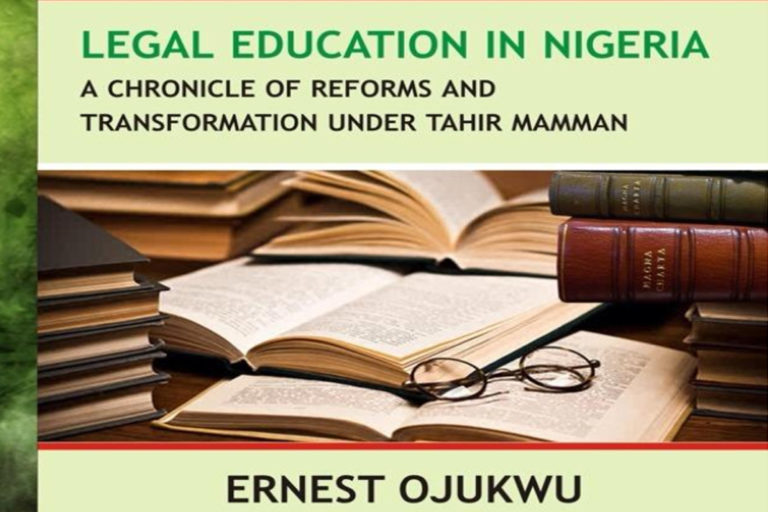
Legal Education in Nigeria: A Chronicle of Reforms and Transformation Under Tahir Mamman by Ernest Ojukwu

Legal Education in Nigeria: A Chronicle of Reforms and Transformation Under Tahir Mamman written by Ernest Ojukwu and published in 2013 is a case study of change that tells the story of opportunities to transform legal education in Nigeria.

We can trace the history of legal education to about 1962 when the first indigenous law faculties and the Nigerian Law School were established.  In spite of deafening calls for many years for reform of legal education in Nigeria, not much was done except that the National Universities Commission introduced a uniform law programme in 1990. The calls for reforms continued thereafter.

The reason for establishing the Nigerian Law School in 1962 was simply to have local content in the preparation of applicants for call to the Nigerian Bar. After this goal was achieved, the Council of Legal Education and the Nigerian Law School made no attempt to set legal education goals or professional goals for its training programme for 45 years. Dr. Tahir Mamman as Director-General of Nigerian Law School made the first real attempt to set in motion a process to discuss reforms of legal education at the Nigerian Law School. The Legal Education Review Committee that was set up by the Council of Legal Education based on this impetus for reforms submitted its report in 2007. The report stated as follows:

“This is the first review of the curriculum and delivery of legal education by the Nigerian Law School since the Unsworth Committee recommended its establishment in 1961. Although the review, coming some 45 years after the creation of the school is belated in the history of Legal Education in Nigeria, it is a welcome development and we hope the Council of Legal Education will consider our recommendations critically.This report by our committee provides the Council of Legal Education with a rare opportunity to change the face of legal education in Nigeria and particularly to upgrade the products of our Law School for the betterment of the legal profession and Nigeria in general.”

Download “Legal Education in Nigeria: A Chronicle of Reforms and Transformation Under Tahir Mamman written by Ernest Ojukwu” LEGAL-EDUCATION-IN-NIGERIA-A-CHRONICLE-OF-REFORMS-AND-TRANSFORMATION-UNDER-TAHIR-MAMMAN.pdf – Downloaded 6737 times – 4.87 MB

EFCC v Paul Usoro: Don’t Railroad us into a Fight with EFCC – Prof. Ojukwu writes Past NBA Presidents

0

Prof. Ernest Ojukwu SAN has written an open letter to all past Presidents of the Nigerian Bar Association (NBA) asking them not to allow the NBA President Mr. Paul Usoro SAN to use them to protect personal interests.

Ojukwu’s letter is coming on the heels of Mr. Usoro’s statement issued earlier today where he indicated that he has informed Past Presidents of NBA of his present ordeal and also revealed that they would soon meet to formulate a common position and issue a statement on the matter.” Ojukwu also frowned at the NBA President’s use of the NBA letterhead in his personal communication referring to same as an abuse of office.

Excerpts

I have read an unsigned statement by Mr. Paul Usoro, SAN dated 19th December, 2018 released as the President NBA on NBA letterhead titled “Purported Money Laundering Charges and Related Matters”.

In that statement Mr. Usoro, SAN acknowledges that his “current travails have roots, in part, in vendetta missions that go right back to the 2015 Akwa Ibom State Election and the 2016/2017 Code of Conduct Tribunal trials of the Senate President…” and that “EFCC has become a tool for fighting personal and political fights.”

Mr. Usoro, SAN clearly knows and shows as he has acknowledged that the charges of money laundering against him are personal to him. Why is he dragging NBA into it? Why is he trying to railroad us into a fight with the EFCC for his personal battle?

Mr. Usoro’s use of the NBA letterhead in this case is an abuse of office in the same way he recently signed the NBA NEC resolutions relating to his charges. This is simply the reason why the NBA past presidents should advise Mr. Usoro, SAN to step aside temporarily and conclude this case very fast.

I am happy that Mr. Usoro, SAN notes broader issues of justice, and rule of law in which he condemns past NBA leadership for not taking up. Regrettably, Mr. Usoro, SAN did not say a word on these issues before he became President and is only saying them now that he has been charged by EFCC. Those fights are fights the NBA must take up or the NBA should completely go dead but Mr. Usoro, SAN should not use that platform to blindfold us into a fight with EFCC for his personal interests.

In that statement released by Mr. Usoro, SAN he stated that “I …kept past presidents of our Association fully informed of my current trials and it is my understanding that they are having discussions amongst themselves and will soon meet to formulate a common position and issue a statement on the matter.”

I hope I read Mr. Usoro, SAN correctly and hope that past NBA Presidents will not as a body be used by Paul Usoro, SAN against the Bar to protect personal interests?

It is on record as much as I know that Past NBA Presidents as a body has never issued any statement on the following:

  1. Unemployment of young lawyers
  2. Very poor salaries paid to young lawyers by law firms
  3. Maltreatment of young lawyers by many senior or older lawyers
  4. Molestation of lawyers by police and other law enforcement agencies
  5. Disobedience of court orders and judgments by Federal and state governments and their agencies
  6. Refusal by State Governments to allow the complete autonomy of the judiciary
  7. Mistreatments and discrimination against our member colleagues in the ministries and agencies
  8. Lack of support to our members with disabilities
  9. Molestation and sexual abuse of our female colleagues in law firms, public and private agencies/companies and our law students in the universities
  10. Terrible state of human right abuse across the country
  11. The terrible security situation in the country
  12. Herdsmen problem
  13. The state of Nigerian economy
  14. The challenges and decline of legal education and the massive abuse of intake quota of law students by universities
  15. Terrible state of NBA accounts
  16. The overpricing without approved budgets of NBA annual conferences and yet poor deliverables
  17. The conflicts and fractionalizations going on in our NBA branches and in some cases massive abuses of financial control and accountability
  18. The shoddy and undemocratic conduct of 2018 primary elections by all political parties in Nigeria which is a harbinger of unfair general elections
  19. The failed anti-corruption programme of the country
  20. The challenges of corruption and ethics in the NBA and refusal of universities to teach ethics in our LLB
  21. The proper recognition and capacity support for our lawyer colleagues in the Police, Army and other law enforcement agencies
  22. The rigging of NBA elections
  23. And many more

Please past Presidents, we need you now more than ever before to help the Bar chart a course for rebirth. But please when you meet advice Mr. Paul Usoro, SAN to quietly focus on his personal charges in court so that he can as soon as possible clear his name and return to lead the Bar positively and effectively. Do not allow yourselves to be used. This case is Paul’s case not NBA’s. The less we try to hang this on NBA the better for NBA and the future of the legal profession.

Season’s Greetings to you all.

Ernest Ojukwu (Teacher)