
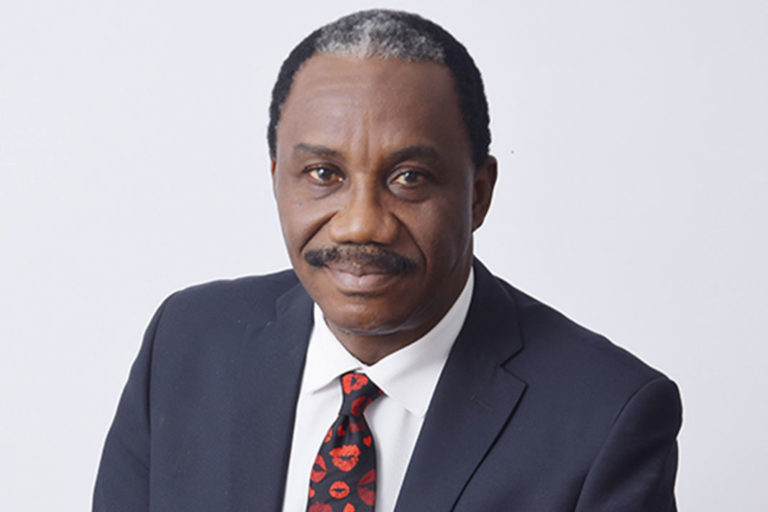
Nigeria at 57: Lawyers Should Reflect As We Celebrate Nigeria–Prof Ernest Ojukwu, SAN
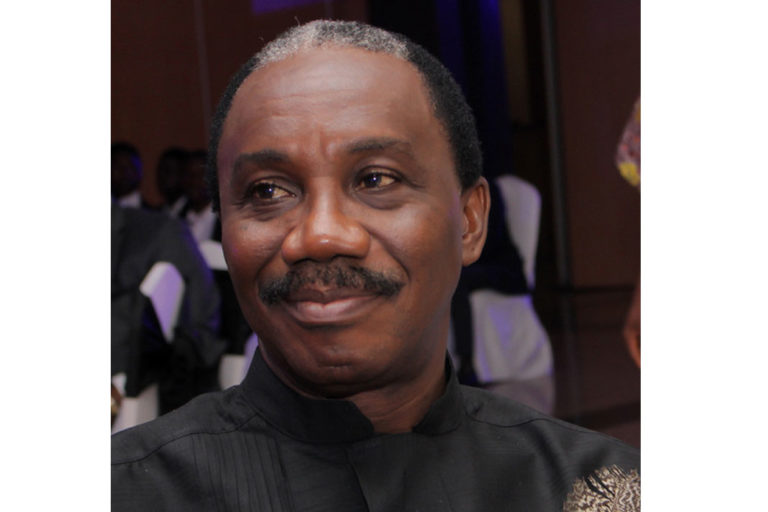
Prof Ernest Ojukwu, SAN has called on Nigerian Lawyers and the Legal profession to reflect on their roles as we celebrate Nigeria at 57.
Prof Ojukwu while felicitating with all Nigerians on the celebration of our 57 years of independence, said that lawyers and the legal profession hold the key to the solution of many Nigeria’s problems and that it was time for a serious reflection on the profession’s roles so far.
Ojukwu raised issues concerning the dwindling public trust on the legal profession, election process, corruption, access to justice, justice education, rule of law and executive lawlessness , good governance, accountability, human rights ignorance, hate speeches and hate, mass unemployment, treatment of the vulnerable group including children, young persons, women, the poor, the physically and mentally challenged, Legislature’s insensitivity and enactment of bad laws, failure of the implementation of the freedom of information Act, and independence of the Judiciary.
He said that the continued failure to tackle these issues will continue to retard the Nation and that Lawyers are best placed to rise and see that these problems are confronted and dealt with urgently.
Prof Ojukwu prayed for unity, peace, economic growth, good governance for the Nation.
Law Professor Urges Lawyers To Protect The Defenseless
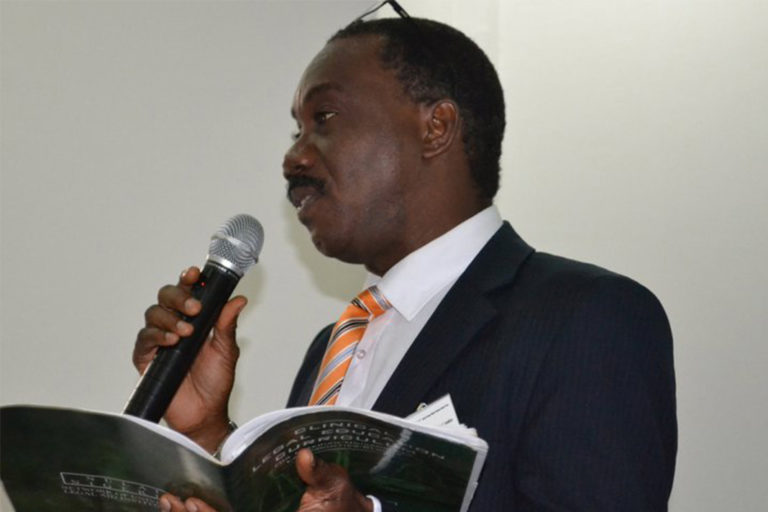
Legal luminary, Professor Ernest Ojukwu, SAN, has tasked the bar to do more to protect the vulnerable people in the society against abuses.
Speaking at Nigerian Bar Association, Ikeja branch of Human Rights Committee, with the theme protecting the rights of vulnerable citizens in our society, Professor Ojukwu who was the keynote speaker at the one day seminar in Lagos noted that the Bar has not done much is this area.
Ojukwu said if the Bar can cure its problem, it can cure the nation.
He said there is no bar initiative on HIV discrimination, stressing that the bar needs to even protect its vulnerable young members from the wolves in the universities. He cited the Human Rights Commission report on abuses in Nigeria in 2015 which put the number of cases of abuse at 47,000.
“This is the 2015 reports of the Human Right Commission. I know that the human right commission is working, doing community outreach programmes and dealing with this particular report,” he said.
Ojukwu explained that the Nigerian Bar Association, NBA can come into these cases through evaluation of initiatives, assessment of initiatives and monitoring initiatives.
On how to protect the vulnerable people in our society, the Don explained that the first step is to perfect the legal framework that can back up any defence mechanism.
According to him: “Once we have a proper framework, then is for us to force the system to implement the laws, in some cases we don’t have the proper frameworks, for example there is no special law on discrimination against women, even though everybody is protected under the constitution but does not give you the real frame work as how to punish those that infringe on that rights. So for women, we don’t have, for children we have, but only in some states, only 24 states have Child Right Act so we need to get others to get the proper frameworks”.
In her welcome address, the vice chairman/ chairperson of Human Rights Committee, NBA, Ikeja Branch, Caroline Ibharuneafe stated that since the inauguration of the committee, they have taken some steps like offering of free legal services to the indigent in the society, including visits to Ikoyi prisons with the support of Ikoyi prison’s DCP and offering of free legal services to the indigent ones.
Mrs Ibharuneafe explained that with the United Nation’s declaration of Human and people rights in 1948, humanity began her accent towards universal brotherhood when man will become his brother’s keeper, adding that since then; national governments and the world all over have made conscious effort to ensure that the protection and enforcement of human rights are made their constitutional duties.
She maintained that civil societies the world all over have complemented the efforts of the government’s by acting as watch dogs or social conscience.
“Nigeria has not been exception in this regard as evidenced by section 36 of the constitution of the Federal Republic of Nigeria 1999 as amended. It is pertinent to point out that even the era of the military rule in Nigeria, the preservation and enforcement of human rights of citizens have always been in the front burners. It does my heart good to observe that the nation’s prime internal security outfit, the Nigerian police Force, has Human Rights Desk in her stations throughout the country,” she said.
In her remarks, the acting director Institute of Humanities, Pan Atlantic University and one of the speakers, Ifeanyinwa Awagu, who came on invitation of international division of women lawyers, Lagos state branch observed that the society needs to work on empowerment of its citizens first.
Is not just the vulnerable alone, the perpetrators also need help, because if we have fewer perpetrators, we have fewer victims, so there has to be a holistic approach to the whole thing which is working on the base, which is the dignity of the human person, she said
She emphasised that the society has to go back to the drawing board to find out what is to be done, “so that the society becomes conscious of the fact that we are human beings”.
Mrs Awagu added that “It could start from the homes, the parents to do their jobs, it could start from faith based organisations, the curriculum, curriculum, education system, I have signed it for so many years integrating character in the curriculum of the school. Recently the Civic education is like it has improved, but then children have to be thought that to be happy in life, need to identify whom you are, Identifying whom you are is that you are a special creature, you can’t give what you do not have, if a male child knows that he’s a special creature from God and that he deserves the dignity, he will be able to respect the woman and rape cases will be reduced.”
Speaking also, one of the speakers at the event, Taiwo Akinlami stressed the need for human capacity development to protect the vulnerable citizens in the society.
He gave the example of Lee Kuan Yew who paid attention to human capacity development in 1965 when Singapore got her independence.
He said: “Lee Kuan Yew focused on human capacity development, understanding that human capacity development starts from the kind of education we give our children. All of these are the issues, until we query our present dominant value system which creates who all of us are today. You treat children the way you see them, you see them the way you were seen growing up, until we query all of that and begin to do a lot of re orientation, I don’t think we are going anywhere and if we are not going somewhere, I think the future of Africa is bleak because what we are doing is what our children are going to be doing if our children are going to be consumers like us.
“I speak for children, I don’t believe the children are vulnerable, what you call child’s vulnerability is simply adult irresponsibility, adult needs to take responsibility, there are18 categories of orphans, vulnerable children, all the 18 categories are human creation not God’s creation”.
Can One Be “Charged To Court”? Prof Ernest Ojukwu SAN
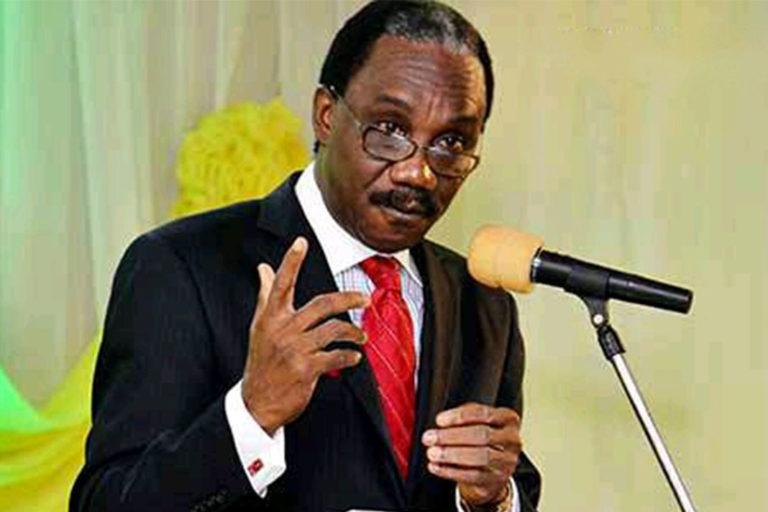
In connection with crime/law many persons speak or write that “Mr A/Mrs A was charged to court”. I have just been reflecting on the correctness of the use of that phrase “charged to court” or “charge to court”. The correct phrase I learnt is that a person can only be “charged in court” and not “charged to court”.
The word “charge” in connection with criminal law is used in two senses- one, as a noun and the other as a verb.
As a noun, the Black’s Law Dictionary defines “charge” as a formal accusation of an offence as a preliminary step to prosecution. As a verb the Black’s Law Dictionary defines “charge” as “to accuse (a person) of an offence”. These definitions from the legal perspective are similar to the definitions provided in the Oxford Advanced Learner’s Dictionary. Our Administration of Criminal Justice Act defines “charge” (noun) as “means the statement of offence or statement of offences with which a defendant is charged in a trial…”
When you charge someone in court it means that you have accused him formally by reading to him the allegations made against him or her. Once that is done, it means that the person has been charged with an offence. It would then likely not be correct to say that, that person was “charged to court”. Surely that person cannot be “accused to court” but can be “accused in court”.
The word “charge” in a criminal legal sense has been extended outside the courts to include the constitutional requirement that “a person who is arrested or detained shall be informed in writing within twenty-four hours (and in a language that he understands) of the facts and grounds for his arrest or detention.” To accuse any person arrested or detained is also to charge the person. So a person can be charged at a police station, in his or her home, in a car, or on the road just as he or she can be charged in court and not “to court”.
NBA PRESIDENTIAL DELEGATION TO KANO 26th June ’17
Teacher was on the NBA Presidential delegation to Kano State on 26th June 2017. The focus of the NBA President AB Mahmoud SAN led delegation was to seek the partnership of the State on NBA project on the expansion of the legal market. The delegation celebrated the Salah with the AB and family, met and had lunch with the Emir of Kano, dinner and meeting with Kano State Governor, watched the very colourful Durbar, and celebrated the 60th birthday anniversary of AB with AB’s family. The delegation was a very strong tteam that included the Chair of the Conference Planning Tech Committee Prof Ajayi SAN, the NBA GS Olagunju, the 1st Vice president Caleb Danjan, NBA Kano Chair Ibrahim Muktar, Prof Yadudu, Chair NBA North-East Task Force Committee, Prof Tabiu, Aliyu Nasarawa, Nasir Dangiri Abdu, Many NBA Kano officers, Members of NBA Conf Tech Committee, other NBA elected officers, Ag NBA Executive Director and other staff, and representatives of Young Lawyers, Dean of Law Bayero Uni etc etc. It was a very successful outing for the NBA. NBA plans to take the expansion of the legal market project to many other states.



Response of Nigerian Lawyers on “Top Ethical Issues” they want Tackled in the Legal Profession – Survey Conducted by Prof Ernest Ojukwu, SAN
In the survey below, Professor Ernest Ojukwu SAN brought to the fore his in-depth ability to conceptualize the many problems of the Legal Profession.
Prof. Ojukwu SAN
For more than ten years, I was deeply involved in the drafting of the Rules of Professional Conduct for legal practitioners and the conduct of many sensitization workshops on the Rules under the Institute of Continuing Legal Education and other ethics workshops under the auspices of the NBA Academic Forum and NBA Branch programmes. At these programmes lawyers complained of and listed many ethical challenges facing the legal profession. I also over these years collated many examples of indiscipline and ethical challenges at the Bar as stated by practitioners, public servants and members of the public which are all in the public domain such as the newspapers and on the internet. There have been calls for the legal profession especially the Bar to look inwards and tackle/stem the tide of indiscipline and unethical conduct among its members.
See for example the Nation’s (Newspaper) report of December 18, 2012 that NBA restates commitment to anti-corruption war (http://thenationonlineng.net/nba-restates-commitment-to-anti-corruption-war/) at the December 9, 2012 workshop- the International Anti-Corruption Day on the theme “Act against corruption today” organized by the Nigerian Bar Association at the Rockview Hotel, Abuja to mark the day. Excerpts of contributions at the mini conference are shown below:
Okey Wali, SAN (President NBA):
Members of the Bar have a seminal role in this new initiative and should not subvert justice by prolonging trials through frustrating applications, including adjournments. The NBA calls on its members to promote professionalism, by shunning sharp practices in the interest of their client, against the society, as part of their contribution to the crusade against corruption.
Yusuf Ali (SAN) said:
“This is a day that represents a shift from what it used to be with us. It represents a day that shows that the NBA is ready and willing to give the battle against corruption its all. The NBA is also showing a signal that corruption in any strata of the Nigerian society is not going to be tolerated, whether it is among the profession itself, its staff and the generality of Nigerians”.
Ali (SAN) said: “From the tone of the speech of our president, and the little comment that I made on that day, it is now clear that there is unanimity among NBA members even among our members who commented to start from within. We must ensure that lawyers themselves are corruption free”.
“The battle against corruption has started and we are starting from among ourselves. So, any lawyer who believes that corruption is the only way he could make it, should have a rethink and may be, join another profession”.
Chief Joe-Kyari Gadzama SAN said:
“Well, it is a good thing that the NBA has equally keyed into the scheme of things using this platform to talk about corruption and fighting corruption. It is indeed a very good beginning, because we have had a kind of self appraisal, a kind of soul searching and we are being self critical”.
“ I believe that this is a good starting point, but we have to go beyond this to make sure that we fight it, not just from the lips, but from the bottom of our hearts and show leadership by example. Those of us that are found to be corrupt, whether they are lawyers or judges should be seen to be punished and it is only then that the public would have confidence and faith in us as lawyers”.
“If lawyers and the legal profession do not fight corruption, then no other agency, or organ of the government or group of persons would fight corruption more than the lawyers because of the nature of our profession, the nature of our training, our experience and exposure. So, I think that the starting point is the lawyers and the judges because the complaint is everywhere, the searchlight has been in our courts against lawyers but lawyers should be seen to be living above board. This will be major plus for Nigeria as a country”.
Dr. Garba Tetengi (SAN) said:
“ I am optimistic, I believe that we all know the problems, so we should begin to look at how we can deal with this cankerworm”
“Well as the chairman has said and I associate myself with it there is a need to look inwards, possible organize a workshop or colloquium in order to sit down and address these problems at the very local level and see how we can make progress. Corruption is an endemic concept, it begins from the house. In fact, it is the culture of impunity that has been inculcated from time, therefore there is a need for us to fight it from all angles”.
M.U. Ibrahim (Jam-Jam):
“We can get rid of corruption by the NBA being very strict on our members, by seriously dealing those found to be corrupt among us, whoever is found wanting should be dealt with, there are no two ways about it.”
At a similar workshop organized by the Nigerian Bar Association, in collaboration with the Presidential Advisory Committee against Corruption (PACC) in Abuja in July 2016, the Chief Justice of Nigeria Justice Mahmud Mohammed through Justice Kudirat Kekere-Ekun was reported to have urged members of the bar to examine themselves, with a view to developing workable ways to curb corruption and charged them to look inward as individuals in the system, and collectively as a body, to improve the legal system.
“You have a role to play as an individual and it is when we all change our attitudes that we can see it reflect in the society.
“No doubt, the legal profession is crucial in the maintenance of a high quality of justice delivery within the justice system and such success or failure of our fight against corruption will depend on our willingness to take the right ethical path,” the chief justice was quoted as saying.
According to the statement, the theme of the workshop was “Anti-Corruption, Ethics of the Legal Profession and Justice Sector”.
(https://www.onlinenigeria.com/site/stories/general/53630-ibrahim-magu-efcc-boss-woos-nba-to-support-fight-against-corruption.html).
Statement of the Problem
The purpose of this study was to determine the response of lawyers to tackling ethical challenges within the profession in order of priority.
Significance of the Study
Everyone whether lawyer or non lawyer will benefit from this study. First the study has given lawyers an opportunity to give a voice to their concerns as it relates to ethical challenges within the legal profession. This in turn gives the legal profession and its leadership a tool to work with at deploying its resources towards tackling the ethical challenges. The study also creates openness and transparency which in turn builds trust among members and consumers of legal services if the Bar sincerely begins to work to tackle the ethical challenges. People/Organizations will be ready to assist the legal profession begin to solve the problems.
Scope of the Study
This study was limited to the perceptions of lawyers from all sectors and from all geographical zones.
Method of Study
Data for this study were collected using a survey form developed by the reporter. The list of ethical issues listed in the survey form was based on the experience and research of the reporter. See “Introduction” above. The survey form had a list of 45 ethical challenges and issues and each respondent was asked to tick only five ethical issues they wished the bar to tackle immediately. The survey forms were administered face to face at lawyers meetings and conferences across the country between May and October 2017. The Bar meetings where the survey forms were distributed were: Afikpo Bar Meeting, FIDA conference Port Harcourt, Young Lawyers group Uyo, Bar meeting Enugu, Bar Abakiliki, and at the Annual Conference of the NBA Lagos. One thousand forms were given out but only 578 were returned.
Limitations of the Study
This study may be limited through the use of survey form as a data collection instrument. Main reason being that the list of ethical challenges on the form was based on the reporters own experience and research. Some of the issues listed may also be similar to each other.
Findings and Conclusion
The findings have been aggregated in the table below. Respondents indicated that the top 5 ethical issues or challenges they want tackled by the bar/legal profession are:
- Bribery of Judges
- Delay tactics in court/using litigation as an instrument of delay/delayed trials/file frivolous applications to delay trials or executions or proceedings
- Bribery of court personnel for processes
- Lawyers’ active role in disobeying court orders/blocking enforcement of orders and judgments
- Rudeness to other colleagues/Impolite attitude
See Table below
AGGREGATE OF RESPONSES FROM THE BAR ON THE ETHICAL ISSUES MEMBERS WANT TACKLED IN THE LEGAL PROFESSION
| S/N | ETHICAL ISSUES | AGGRE-GATED RESPONSES | % |
| 1 | Bribery of judges | 190 | 6.94 |
| 2 | Delay tactics in court/using litigation as an instrument of delay/delayed trials/file frivolous applications to delay trials or executions or proceedings | 182 | 6.65 |
| 3 | Bribery of court personnel for processes | 176 | 6.43 |
| 4 | Lawyers’ active role in disobeying court orders/blocking enforcement of orders and judgments | 149 | 5.44 |
| 5 | Rudeness to other colleagues/ Impolite attitude | 149 | 5.44 |
| 6 | Advise disobedience to court orders | 120 | 4.38 |
| 7 | Litigating every matter even when ADR should have been advised or used | 109 | 3.98 |
| 8 | Lack of transparency in NBA accounts | 107 | 3.91 |
| 9 | Not following simple court etiquette/ Disorderliness in court | 104 | 3.8 |
| 10 | Sell grades to law students;/Receive money from law students to influence results | 83 | 3.03 |
| 11 | Bad dressing in court and formal lawyer’s occasions | 80 | 2.92 |
| 12 | Receiving money from clients in pretense that the money would be paid over to judges, police etc but do not pass on the money. | 77 | 2.81 |
| 12 | Lying in court | 77 | 2.81 |
| 14 | Struggle for food and snacks at public functions/ not queuing up for food and snacks at bar functions/ Jump queues | 76 | 2.77 |
| 15 | Oppose bail applications without any valid reason | 68 | 2.48 |
| 16 | Solicitation for brief | 67 | 2.44 |
| 17 | Converting client’s fund | 64 | 2.34 |
| 18 | Combining legal practices with other incompatible businesses | 61 | 2.23 |
| 19 | Conflict of interest | 61 | 2.23 |
| 20 | Convert NBA money to personal use | 61 | 2.23 |
| 21 | Taking brief at client’s house or office | 50 | 1.82 |
| 22 | Bribing officials of all government agencies to file or retrieve any document or information | 49 | 1.79 |
| 23 | Sexually molest our law students as law teachers | 46 | 1.68 |
| 24 | Lawyer as prosecutor take money from the defendant and institute a frivolous charge or a lenient charge; oppose bail when not paid; don’t oppose bail no matter how serious the charge may be or how simple for the defendant to jump bail as long as money has been paid | 45 | 1.64 |
| 25 | Bribe policemen on client’s behalf to solve client’s problems or block the flow of justice | 44 | 1.6 |
| 26 | Convert client’s property | 43 | 1.57 |
| 26 | Steal files from court with the collusion of court officials | 43 | 1.57 |
| 26 | Rig NBA elections | 43 | 1.57 |
| 29 | Suppressing information on judicial decisions not favourable to your case | 38 | 1.38 |
| 30 | Partnership between lawyers and other professionals like accountants, surveyors, etc | 36 | 1.31 |
| 31 | Not maintaining a client’s account | 34 | 1.24 |
| 32 | Presenting distorted judicial opinions and decisions in support of one’s case | 33 | 1.2 |
| 33 | Create a litigation where the party is both defendant and “plaintiff” | 32 | 1.17 |
| 34 | Mixing client’s money with firm’s money | 31 | 1.13 |
| 35 | Wrongful Advertisement | 30 | 1.09 |
| 35 | Fake documents for election cases and other cases | 30 | 1.09 |
| 36 | Give and receive money to vote at NBA elections | 29 | 1.06 |
| 37 | Lie as a way of life | 28 | 1.02 |
| 38 | Extort money from clients | 23 | 0.84 |
| 39 | Over billing clients | 15 | 0.54 |
| 40 | Pay filling fees to beat limitation date but file later than limitation date with the collusion of court personnel | 14 | 0.51 |
| 40 | Collude with opposing client or opposing client’s counsel to the prejudice of your own client | 14 | 0.51 |
| 42 | Pay money to Dean of law/HOD/other official to receive law school form | 10 | 0.36 |
| 43 | Drive on curbs and road shoulders | 8 | 0.29 |
| 44 | Litter our environment | 6 | 0.21 |
| 45 | Falsify faculty records for accreditation purposes | 5 | 0.18 |
Report Prepared by:
Prof Ernest Ojukwu, SAN
23RD January 2017
The Global Face of the Ethical Lawyer
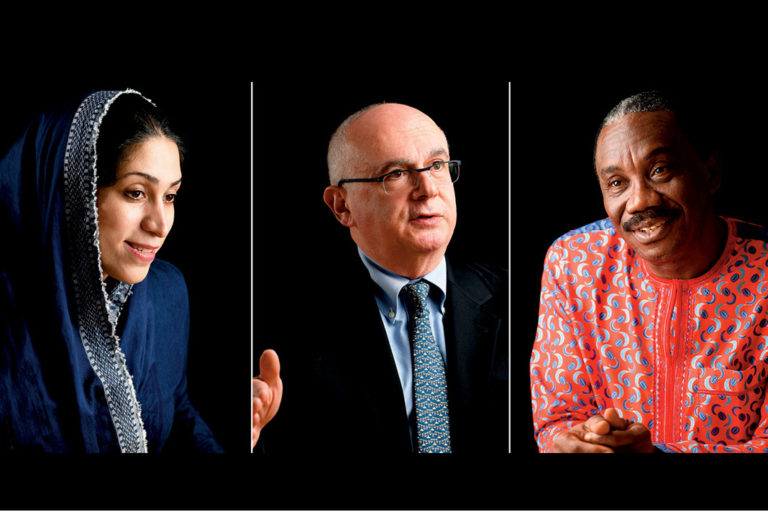
Legal professionals from around the world talk about ethics.
Over three days in July, Fordham’s Stein Center for Law and Ethics welcomed prominent academics, practicing lawyers, and regulators for the seventh International Legal Ethics Conference. The event, spearheaded by Stein Center Director Bruce Green and Associate Director Sherri Levine, featured more than 80 programs on a range of topics including access to justice, international rule of law, challenges to judicial integrity, and professional regulation.
More than 400 participants from 60 countries attended.
Here, nine of them speak about their experiences.
Ernest Ojukwu | Nigeria
With the many problems concerning legal ethics in his home country of Nigeria, it was not easy for Ojukwu to find sponsorship to attend ILEC.
“When discussing problems facing the nation, people identify ethics, corruption, and lack of discipline as challenges,” he said. “But when you ask for action, these problems are taken off the table. It is difficult to find institutions that have enough funding to fight the problems of ethics and lack of discipline.”
Ojukwu has been heavily involved with integrating legal ethics into Nigerian culture, especially at universities throughout the country. He is also very active in the Nigerian Bar Association and is currently focusing on access-to-justice issues, especially in litigation.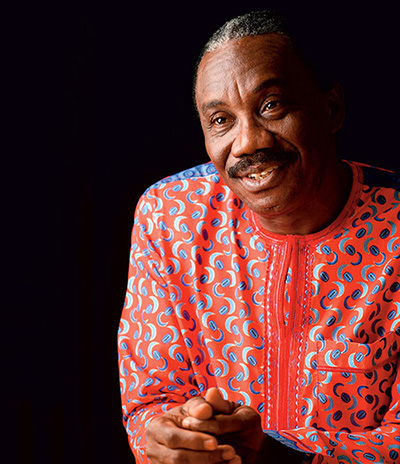
“I am very interested in building a culture of ethics in my home country, particularly at the educational level. So I am excited to see and hear from colleagues who have taught ethics and to learn how they have integrated ethics into their cultures.”
At ILEC, Ojukwu spoke about integrating the concept of legal ethics at the academic level. His panel, “Actions Speak Louder Than Words: The Ethical Law School,” discussed the challenges various institutions from around the world face with improving legal ethics training.
“The best forum to talk about legal ethics is at the educational level, particularly starting when students are at a younger age,” he said.
Ojukwu has been practicing law since 1984 and is a professor of law in Nigeria. He also serves as president of the Network of University Legal Aid Institutions (NULAI).
“The NULAI in Nigeria has helped about 19 law faculties establish law clinics, for which we were able to develop an ethics curriculum and integrate into the mainstream of law school clinical courses,” he said.
Ojukwu and his fellow ILEC panelists encouraged participants to reflect on what is right and wrong in regard to legal ethics, as well as to discuss measures that can be taken to train law students to become more ethical lawyers, in spite of the many challenges imposed by society. He noted that the conference’s diversity is integral to facilitating such changes.
“The diversity of participants at the conference is very important. Ethics is an international problem. Because cultures differ, it is fundamental to understand how each country is grappling with the challenges of ethics. With that kind of diversity we can learn a lot from each other.”
Ahmed Al-Hawamdeh | Jordan
Al-Hawamdeh, an associate professor of corporate law at Jerash University, traveled to ILEC so that he could learn from other countries’ experiences and implement better practices in Jordan.
“I expect to get a feel for what’s going on around the world and hopefully find solutions to problems that we encounter back home in Jordan,” he said. “Jerash University is trying to better prepare students for the market and not leaving it up to the chance of them having good training after they graduate. We really want to make sure that our students are acquiring the skills they need.”
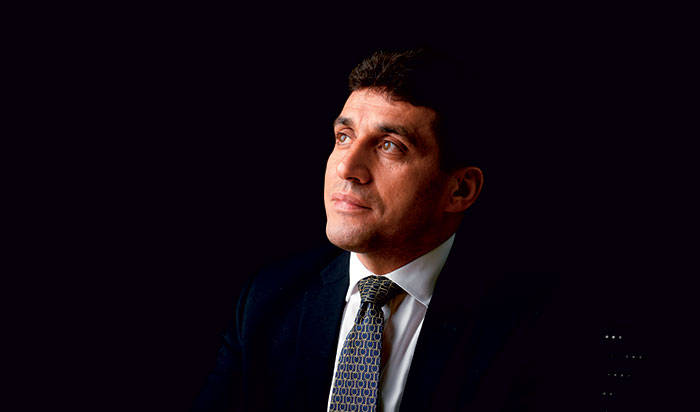
Since legal ethics is not a focus of the curriculum at Jerash (a relatively new university only 25 years old, with approximately 300 students), Al-Hawamdeh had a difficult time finding sponsorship to attend ILEC. Fortunately, he was one of about 40 participants who received a travel subsidy disbursed by Fordham Law.
Speaking on the same ethics-in-legal-education panel as Ojukwu, Al-Hawamdeh believes ILEC provides an invaluable opportunity for meeting people from all parts of the world.
“The conference is a great chance to talk with people and hear their different perspectives,” he said. “Based on others’ experiences, I will hopefully learn something that I can take back home to Jordan.”
Al-Hawamdeh earned his undergraduate degree in his home country, later studied in Scotland at the University of Aberdeen, and then obtained a Ph.D. in England. Since his return to the Middle East, he has worked tirelessly to reform Jordan’s system of legal education, including involving students more in issues related to helping the underprivileged or those who don’t have access to justice.
He feels the international range of academics at ILEC is the key for improving legal ethics, because it is a venue where everyone can share their experiences and solutions.
“In order to prepare students on ethical issues, you need to have common solutions,” he said. “What you learn from looking at others’ experiences and how they manage to overcome the obstacles they face gives you strength to carry on and believe that something will come of it.”
Olga Churakova | Kyrgyz Republic
Access to legal aid is a global concern. Defense lawyers, who serve as protectors of the human right to due process and a fair trial, face challenges in every country. Without access to effective legal counseling, individuals are at risk of being detained arbitrarily or illegally—or worse, they may even be wrongfully convicted or subject to torture.
Motivated to right these wrongs, Churakova directs the Advocates’ Training Center in the Kyrgyz Republic to improve the professional knowledge of advocates so that they can provide the highest level of quality legal service to the country’s citizens. By traveling to ILEC, Churakova hoped to learn new ways in which she could increase opportunities for advocates and spread awareness of legal ethics norms in her country.
 “With participants from more than 60 countries present at the conference, there is a very interesting opportunity to learn everything about legal ethics throughout the world and to improve the systems of our countries where we are living and working,” Churakova said.
In 2014, the Kyrgyz Republic developed a new legal ethics code for advocates, which paved the way for the inclusion of ethics training in basic courses. Churakova noted that one of the biggest challenges surrounding legal ethics in her country is advocates having to deal with conflicts of interest while remaining ethical.
“I think that every advocate has struggled with some difficult ethical question in their professional career, but oftentimes there is no one for them to consult with on what to do in such a situation,” she said.
At ILEC, Churakova spoke on the “Building Defense Bar Capacity to Ensure Equality of Arms” panel. She said that advocates in the Kyrgyz Republic are not generally held in the same regard as judges and prosecutors.
“The advokatura [the bar]has to be put on the same level as the prosecutor’s office in order to protect human rights. We are trying to disseminate our new ethics code and improve advocates’ training,” she said.
The Advocates’ Training Center intends to continue the process of improving legal ethics training of advocates and lawyers of the country through teaching sessions.
“Networking at the conference was extremely important to discussing legal ethics issues. It was a great opportunity to meet the specialists and experts
from around the world,” Churakova said. “I’m very glad to have been invited. I would have never imagined I could have attended such a conference. It is exciting to learn the experiences of other countries.”
Suphamat “Bee” Phonphra and Nattakan “Ann” Chomputhong | Thailand
Jetlagged but excited for their first visit to the United States to attend ILEC, Phonphra and Chomputhong came as representatives of Bridges Across Borders Southeast Asia Community Legal Education Initiative (BABSEACLE), an international organization working to strengthen access to justice, legal ethics education, and community empowerment.
At the core of BABSEACLE’s mission is the belief that access to justice is an ethical responsibility. Through clinical legal education, the organization aims to foster community service–minded lawyers and pro bono advocates to help extend legal assistance in often marginalized communities.

Phonphra, an access-to-justice initiative coordinator, and Chomputhong, a legal trainer and legal ethics and professional responsibility initiative coordinator, were drawn to work with BABSEACLE because they saw firsthand the lack of adequate legal ethics education in Thai universities, a situation that is only recently beginning to change.
“When I was a student, the lectures did not inspire me about how to be a good lawyer,” said Phonphra. “I didn’t know until I had worked for four or five years, and now I understand more.”
“My university was a bit different,” noted Chomputhong. “When I was a student we had legal ethics, but just one credit, so we did not learn much.”
Now both women train lawyers, students, and educators throughout Asia, using an interactive and practical curriculum for teaching legal ethics created by BABSEACLE in collaboration with international law firms, teachers, and government partners.
The BABSEACLE curriculum provides a needed core structure of legal ethics education, which can be adapted to different legal systems depending on the country in which it is taught.
So far the curriculum has been implemented in several Southeast Asian countries, including Thailand, Vietnam, Laos, Cambodia, and Myanmar.
In their ILEC session, Phonphra, Chomputhong, and two BABSEACLE colleagues modeled their interactive approach to teaching the curriculum, which uses group work and role-playing to have students engage with real ethical issues they would encounter in practicing law.
Though both women acknowledge that there is still much work to do to spread legal ethics education throughout Asia, they have seen progress since working with BABSEACLE.
“Through the clinical legal education program, not just lawyers but also students who work in the clinics provide free legal advice and also do community teaching,” said Chomputhong.
Going forward, both women hope to encourage more regional people to get involved in their movement and also further cultivate the interchange of ideas and resources with international lawyers and educators, as they did at ILEC.
“We would welcome more suggestions for effective methods or tools that we can use to improve legal ethics teaching in Asia,” said Chomputhong. Referring specifically to lawyers and educators from non-Southeast Asian countries, she continued, “They are welcome to come and assist in any training provided, any materials they can share.”
Phonphra seconded Chomputhong’s call for further international collaboration. “Contact us!” she said with a broad smile.
Zoha Savadkouhifar | Iran, Pakistan
When Savadkouhifar was a legal adviser and researcher in Iran, she had the opportunity to evaluate the state of legal ethics in the country by working with different judiciary departments and academic programs such as legal clinics and also studying the larger context of Iranian constitutional law.
She recognizes that Iranian constitutional law and other legislative and administrative laws already provide structures and procedures to oversee and regulate the behavior of lawyers and judges, and she understands that constitutional law in Iran incorporates Islamic law, which sets forth specific rules for the independence and impartiality of judges. However, she believes that laws alone cannot ensure justice if lawyers and judges are not educated in how ethics should be applied in the many facets of their professional practice.
 “We all know that when the person is not trained, whatever the law is won’t work,” she said.
For Savadkouhifar, currently a Ph.D. candidate at Shaheed Zulfiqar Ali Bhutto University of Law in Pakistan, what is needed in Iran is a stronger commitment to legal ethics education in the country’s law schools.
She has seen the consequences of inadequate training; she once confronted a family court judge who was compelling a woman to stay in a marriage because the judge did not believe the behavior of the husband was harsh enough to grant the divorce the woman was seeking.
“I told him, ‘This woman came to your court to access justice. You are violating her more than her husband is,’” she said.
In the past few years, Savadkouhifar has seen some progress in Iran, including the introduction of legal ethics courses and legal clinics in universities; workshops for judges, police officers, and court workers; and discussions of legal ethics by bar associations.
“What I can say is that I am hopeful for the next generation,” she said.
One area in which she has passionately applied her expertise to bring about change is juvenile justice, where important advancements have been made recently. Savadkouhifar has played key roles in some Iranian national projects, including “Model Law on Management of Juvenile Correctional Departments” and “Developmental Crime Prevention through Schools for Children at Risk,” now implemented in three pilot schools.
Savadkouhifar, whose husband is from Pakistan, where they now live, is currently a member of the Pakistan bar association. At ILEC she spoke on a panel titled “Legal Ethics and Legal Education in Two Islamic Republic Countries,” and she is eager to continue learning about legal ethics in international and comparative contexts. She is now an LL.M. student at Penn State Law and will continue her Ph.D. in Pakistan next summer.
“If we really want to do such things as policymaking in my country, nowadays we cannot do anything if we don’t know what is going on in the international environment.”
Martin Bohmer | Argentina
“In Argentina, the joke is that legal ethics is optional,” said Bohmer, opening his ILEC presentation as part of a panel on the state of legal ethics in Latin America.
Though the remark was met with genial laughter by the assembled panelists and audience members, it pointed to a serious reality of legal education in Argentina.
“Mostly there are no courses on legal ethics,” said Bohmer. “And when we do teach it, it’s an optional subject in the law school.”
As a professor of legal theory at Universidad de Buenos Aires Law School, where his own legal ethics course is optional, Bohmer has often had to convince his students that the subject is not a trivial matter.
“So the first thing I found that I needed to do in the classroom was to create a sort of gravitas in the atmosphere—to put things in a more dramatic light,” he said.
In the classroom, Bohmer tries to awaken students to the life-altering impact their work as lawyers may have on others.
“You are going to take away children from someone, you are going to put somebody in prison, you are going to destroy relationships, you are going to start a bankruptcy of a corporation,” he tells them.
He hopes to cultivate a reflective capacity within his students that will help them take proper actions as lawyers.
Bohmer also wants his students to see the way legal ethics are connected to a much broader national context and serve as the foundation for the rule of law in Argentina as a whole. His point is that if lawyers fail to act in good faith, are dishonest or unscrupulous, then codes of procedure cannot work as they should.
“If you cannot make a code of procedure work, then you cannot make the civil code, the criminal code, the law work,” he said. “And if you cannot make the law work, you cannot make the constitution work.”
His students’ attitudes change, he said, “once they realize that we are dealing with legal ethics not just to be nice but to fulfill the role of the lawyer in a constitutional democracy.”
Currently, Bohmer is serving as national director in the Ministry of Justice of Argentina, where he is assisting in the first-ever process of accreditation of law schools. As part of this project, law schools across Argentina have recognized the need to include legal ethics courses, though a lack of qualified faculty and necessary teaching materials often hinders the achievement of this goal.
“So my job now is to finance the development of materials to teach, and then with those materials to train the trainers who will teach,” said Bohmer.
Russell Pearce | New York
Hip hop rhythms from the acclaimed Broadway musical Hamilton played in the background as participants assembled for an ILEC session discussing relational perspectives on ethics and the legal profession, the first of its kind at an international legal ethics conference.
As the music faded out, Pearce, the session’s moderator, explained the musical’s connection to the subject at hand.
“Hamilton was, after all—whatever you think of his politics—a person who valued the role of relationships in politics,” he said.

A professor at Fordham Law since 1990, Pearce has focused on relational theory as an important part of his examination of what creates a just legal system and the role that lawyers play in providing justice in society.
His work on relational theory questions the widely held “atomistic” view prevalent in law, business, and politics today, which sees individuals and organizations operating separately from each other.
“An atomistic actor in any of these areas thinks, ‘What can I get away with?’” said Pearce.
According to him, the atomistic actor “is the measure of self-interest, because you are separate and your self-interest doesn’t have to take into account your friend, your neighbor, your colleagues, or your community.”
For Pearce, the consequences of this mindset can have damaging consequences in our society, including “incivility in politics, short-term thinking in business, and hired-gun approaches in law,” he said.
In reality, “it’s a myth that anyone or any organization is atomistic,” he said.
“Every successful lawyer, every successful business person recognizes at some level that their success depends on their relationships.”
Debunking the atomistic myth is necessary to fight narrow self-interest, he said, and on a broader level, combat the problems of income inequality and gender and racial injustice.
Pearce, who is Jewish, also focuses part of his work on religion and law, cultivating among lawyers who are religious a dialogue about how faith can inform legal practice and education. He serves as the faculty director of Fordham’s Institute on Religion, Law, and Lawyer’s Work.
His broad interests include the study of the ways that new technologies, such as online legal services company Legal Zoom, are changing the profession and the market. Though these technologies can provide legal assistance to those who perhaps could not otherwise afford it, they are currently unregulated in the United States.
“As we better understand where technology is going, we’ll have a better understanding of how to regulate in the interests of protecting consumers, protecting society, and providing broad access to justice,” he said.
Xiaobing Liu | China
Having studied law in the United States and China, Liu has a solid understanding of the differences in legal ethics education in the two countries.
In his view, China is making progress but still lags behind the United States and other western countries in instilling legal ethics in students and addressing problems with conflicts of interest, breaches of client privacy, and other forms of misconduct on the part of lawyers.
“In China the economy has grown up, but rule of law is backward, so there is a difference,” he said. “In the United States and most western countries the rules are very detailed; in China they are far from detailed.”
As a professor at China University of Political Science and Law, he is doing his part to improve the situation as the director of the only university department in the country devoted to the study of legal ethics.
Liu and his faculty of 11 professors are part of a movement to professionalize the study of law in China, where a student does not need to attend law school before taking the bar exam.
In his ILEC talk, Liu outlined recent legal ethics reforms set forth by the Chinese central government, and also the challenges faced in their implementation, including inconsistent standards among government offices, underdeveloped educational programs, and a lack of qualified faculty.
“In China the situation is getting better, but we still have a lot of problems,” he said. “That’s why we call it a crisis of legal ethics because many lawyers do not comply.”
To illustrate his point, Liu gave the example of the much-publicized case involving Tianyi Li, the teenage son of a Chinese general convicted of rape in 2013. In the trial, Li’s lawyers attacked the credibility of the victim, described her as sexually promiscuous, and made her medical records public.
Liu himself is committed to doing pro bono work and serving in the community. “I devote my time to those who need legal aid,” he said. “In my university I also have a legal clinic. I lead, guide, and instruct the students to help those who are poor.”
Though Liu feels optimistic about the future potential of legal practice in China, he also knows real change won’t happen overnight.
“Of course it takes time to implant the idea of legal ethics in every lawyer’s mind,” he said.
Story by Samantha Mathewson and Nina Heidig, photographs by Chris Taggart
Celebrities unite against human trafficking

The city of Lagos is bound to come reverberate on Sunday, February 28, as top Nigerian celebrities take to the football pitch to support the fight against human trafficking.
Billed to hold at the Campos Square Stadium, Lagos Island, Lagos, movie star Richard Mofe Damijo, popularly called RMD, will lead 11 other stars to square up against former Super Eagles striker and captain, Kanu Nwankwo’s team.
Former Super Eagles coaches, Shaibu Amodu and Christian Chukwu, will coach Team Kanu Nwankwo and Team RMD respectively while actresses Ireti Doyle and Apostle Eucharia Anunobi will each play five penalties to determine the winners at the end of the day. The initiative, a project of Next2None support group, is tagged ‘Africa, My Africa Walk Against Human Trafficking Legendary/Celebrity Football Match.” Owerri, Imo State capital will play host to the stars after Lagos, followed by Accra, Ghana which holds later this year.
Announcing the event to newsmen in Lagos, Professor Ernest Ojukwu, SAN, who delivered the keynote address called on all to join hands in the fight against human trafficking even as he described the menace as “the biggest social menace in the world today. It is a global trade in human beings, whether for forced labour or sexual exploitation. It is estimated that between 12 million and 27 million people are enslaved around the world and the biggest chunk of this trade emanate from Africa, Nigeria strongly inclusive. The reality is that the abolishment of slavery only abolished the process. There are more slaves today in the world than at any other point in human history. More processes for dealing in slavery have also emerged,” Ojukwu said.
Barrister Ndukwe Sam Obu, Founder/Chairman BoT of Next2None support initiative, said “I want to inform all that after the Lagos and Imo events, the capital city of Ghana, Accra is ready to play host to an array of African stars as they march in solidarity against the social menace of human trafficking. The African ambassadors will also play a charity football match at the Accra Stadium after the morning match.
“As I speak, about 100 African celebrities from the movies, sports, comedy, religion, music among others, have been contacted to be part of the project. They are: Senator George Opon Weah, Ambassador Roger Milla, Lucas Radebe, Gen Lanre Apata (RTD),Chief Awa U Kalu (SAN),Rear Admiral Peter Ebeleheme (Rtd), Major Gen Yakubu Usman(Rtd), Prof Ernest Ojukwu (SAN), Rev Biodun Fatoyinbo (Minister-in-Charge COZA),Pastor Mrs. Modele Fatoyinbo (COZA), John Fashanu, Rachel Bakam, Chief Acho Ukaha and Hajia Titi Abubakar. Others are, Christian Chukwu, Hajia Laradan Shuaibu, Keppy Ekpeyong, Zack Orji, Coach Samson Siasia, Juliet Ibrahim among others.
ERNEST OJUKWU SAN – ALOMA MUKHTAR’S LEGACY OF MERIT
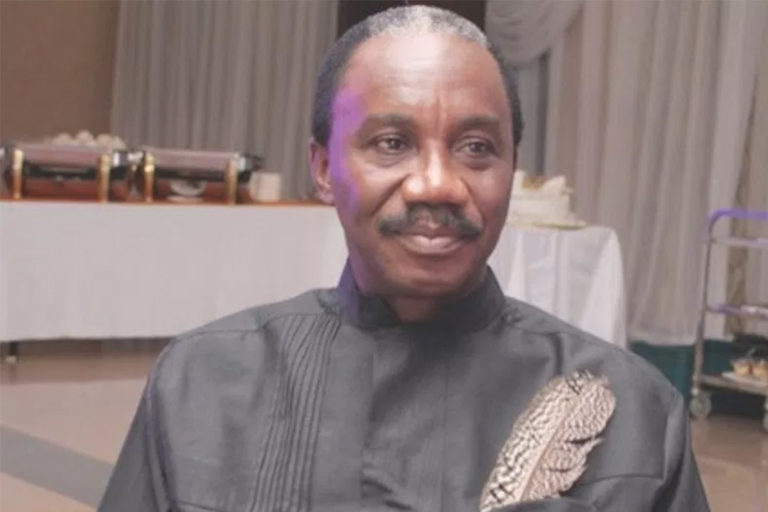
One outstanding name on the 2014 list of Legal Practitioners conferred with the rank of
Senior Advocate of Nigeria(SAN) is Professor Ernest Ojukwu, SAN; currently, Partner at Ofy-lawyers.com; President, Network of University Legal Aid Institutions(NULAI Nigeria);
Associate Professor of Law, since 1998; Dean, Faculty of Law, Abia State University, Uturu
(1995 to 2000); Deputy Director-General and Head of Augustine Nnamani Campus, Enugu,
Nigerian Law School from 2001 to 2013; Deputy Director-General and Head Quality
Assurance Nigerian Law School (2013-2014); Director, NBA Institute of Continuing Legal
Education (2007-2010 & 2012-2014); and External Examiner, Kenyatta University School of
Law, Nairobi. The list is endless!
However, Professor Ernest Ojukwu, SAN is an humble, unassuming, distinguished living
legend and icon of the legal profession; but who before now was denied this requisite
honour. This is a man close associates call different names, “Ernest”, “Teacher”, “Prof.”,
“the father of clinical legal education in Nigeria”, and the Gbaonwa-Gbaonwa Agbaonelu, of
Ahaba Imenyi, Isuikwuato Local Government Area of Abia State. He represents many things to many people-both friends and foe, within and outside Nigeria, but you must give it to him- he is a teacher, mentor, renowned advocate, great thinker, eminent scholar,
administrator, and everything hard work and integrity personified.
For those of us that have known this legal icon closely, and worked with him, we easily
said, it is an honour long overdue; but it has come. Congratulations, Professor Ernest
Ojukwu,SAN. It is not the time that matters, but the worth in terms of merit. His
contributions to the legal profession speak for itself. We commend Chief Justice Aloma
Muktar whose candour made it possible. This is a call for positive change.
There is no doubt that the retiring first female Chief Justice of Nigeria, Justice Aloma
Muktar has done well in many areas, comparatively far and above her predecessors. She
ventured into thorny areas where her predecessors either ignored or played along for
obvious reasons. This trail-blazer for the womenfolk has left some remarkable legacy that
gives assurance that all hope is not lost after all. One such significant legacy is integrity-
that value described as comprising accountability, competence and ethics excluding
corruption.
Integrity is one value that discerning Nigerians cherish when professed at the highest
offices of the nation. Unfortunately, the trend is to progressive disappearance of integrity as corruption, nepotism and other anti-integrity challenges steadily creep in. In the milieu,
merit is dumped for mediocrity, hard work is discarded and mediocrity is endemic. As we
watch national ethics, and ostensibly values nose-dive even within the noble profession,
many continue to wonder whether it could still be recharged. We have witnessed one bold
conscious effort during Justice Muktar’s tenure, ensuring that merit counts in selection of
legal practitioners for conferment of SAN.
In the past few years the manner of conferment of the rank of Senior Advocate of Nigeria
to legal practitioners has raised some dust and divided the Bar. Some had called for
abolition of the rank because the process of selection of conferees was allegedly everything
but lacking in integrity and fairness. It lacked transparency. But conferment of SAN to
deserving members is supposedly a mark of honour and distinction; recognition of hard
work, and should really encourage hard work.
Professor Ernest Ojukwu’s name on the list of conferees of the rank of SAN for this year
supervised by the retiring Chief Justice Aloma Muktar, is heart-warming to members of the
profession who yearned for the day merit and hard work could be accepted as precise
yardstick for award of honour. It is also an inspiration for us to work hard and achieve
merited honour which we can cherish for a long time. It is a challenge to incoming and
future Chief Justices and all involved in the selection for conferment of SAN and other
honours in Nigeria that integrity is celebrated, noble and satisfying. In the past the likes of
late Gani Fawehinmi had similarly worked hard but suffered long deprivation that the
average Nigerian queried the conferment process.
In the limited scope of this article, one cannot adequately report the contributions of
Professor Ernest Ojukwu, SAN, to the legal profession; but we can throw insight into the
making of the legal icon, and justifying this conferment on merit.
Ernest Ojukwu, SAN was called to the Nigerian Bar in 1984, after graduating with honours
from the Nigeria Law School and the famous Obafemi Awolowo University, Ile-Ife. On his
return from National Service, he joined the Nigerian Bar Association, and is a member of
the Aba Branch of the Association.
Since joining the Bar, Ernest Ojukwu, SAN, has been active with record of service at the
local, regional and national levels. Check out some of the positions he has held so far:
Secretary, NBA Aba Branch (1992-1993); Chairman, NBA Aba Branch (1997-1999); Sole
Member NBA Sub Committee Y to Investigate Complaints Against Legal Practitioners, 1999;
Chairman, NBA Law Reform Committee (2002-2004); Founder, President, NBA Eastern Bar
Forum (2004-2011);Chairman, NBA Legal Education Committee (2006-2008); Co-Chair,
NBA Editorial Committee (2002-2004); Chairman NBA Editorial Committee (2006-2008);
Chairman, NBA Academic Forum (2003-2004; 2006-2008 & 2012-2014); Co-Chair, NBA
Conference Planning Committee 2003;Alternative Chairman, NBA Summit on the Future of
Legal Education in Nigeria 2006; and Chairman NBA Strategic Plan Working Group 2012.
He has been member of many other NBA Committees since 1999 and in the various
positions he held and committees he served, he has exciting achievements to present. As
Chair of NBA Law Reform Committee he produced a new Legal Practitioners Act in 2004
under President Wole Olanipekun, SAN. In 2006, the NBA under President Olisa Agbakoba
SAN rather requested an amendment in place of a full blown new Act and Ernest Ojukwu
submitted an amended Legal Practitioners Act which then was submitted to the National
Assembly. In 2011, the NBA under President Daudu SAN set up a new Committee to draft a
new Legal Practitioners Act. Ojukwu produced a new draft for the Committee and that draft
is basically the bill before the National Assembly today. In addition to the Legal Practitioners Act, Ojukwu also submitted to the Bar draft bills on Legal Education and Legal Services Commission. This is also presently before the National Assembly.
In 2006, an ad hoc committee made up of President Olisa Agbakoba, Secretary Lawal-
Rabana, SAN and Prof. Ernest Ojukwu reviewed the Justice Orojo’s draft on Rules of
Professional Conduct for the Bar. The final copy, which is the present applicable Rule was
drafted by Ojukwu. In 2007, Ojukwu also produced for the Bar the Rules governing the
Mandatory Continuing Legal Education Programme. It will be recalled that Prof. Ojukwu was
the first person to call for a mandatory continuing legal education programme for the Bar in
1999 at NBA Annual Conference at Ilorin under President TJO Okpoko, SAN.
He resuscitated the NBA Journal- Nigerian Bar Journal in 2002 and between 2002 and 2004
as Editor-in-Chief, published seven editions. As Chairman of the Legal Education Committee
he produced guidelines for setting up a Legal Education Trust Fund but unfortunately the
Bar has not paid attention to that. In the same way, as Chairman of the Academic Forum
he produced a separate Code of Conduct for Law Teachers following massive reports of
unethical behavior by many law lecturers against law students and legal education in
Nigeria-a misbehaviour that has remained unchecked in many universities till today.
Regrettably, the Bar has done nothing up till date with the Code of Conduct.
Ernest Ojukwu’s contribution and influence in the legal profession transcends his long
service to NBA, to include legal education and legal education reform. With his outstanding
results and some of the best in his class at the University and Law School, he was quickly
engaged by the then Imo (now Abia) State University to beef up its then famous Faculty of
Law at Aba. In this Faculty, the then young Ernest joined the likes of late Professors Osita
Eze and Oye Cukwurah, who both identified his talent, and bestowed so much trust and
confidence in his capacity and capabilities. It was at this point that the present writer met
this special breed of SAN for the first time as his student in 1985 at 300 level Criminal Law
class. In that class were some other notable persons of today’s Nigeria, including Senator
(Chief) Anyim Pius Anyim, Professor Chidi Anselm Odinkalu, Mr. Eze Onyekpere, Justice
Steve Evoh, Justice KK Ojiako, Justice A.C. Chioma, Dr. Nat Ofo, Dr. Chris Anyanwu and so
many others. Each time we remember those days with nostalgia, we always recount his
very first impromptu test in Criminal Law class. His assessment gave a jolt to the class and
we had to sit up. From that point, this man meant many things to many of us depending on
individual attitudes to integrity and hard work. In the years to follow, he taught the likes of
GUK Igwe, SAN, Elder Paul Ananaba, SAN, Justice Ken Amadi, Justice Evelyn Anyadike,
Justice Ahuchogu, and so many big players in the legal profession. He later became the
Dean of the Faculty of Law, Abia State University, Uturu from where he joined the Nigerian
Law School as a Deputy Director General. But before then, he had mentored, and continues
to mentor some of us. He is friend and mentor to you once you can work hard and show
integrity. Decades after graduation, we celebrate his integrity and candour-we celebrate
this recognition of his hard work and integrity-and Justice Aloma Muktar’s legacy of merit.
Sometime about 1996 Professor Ojukwu did an article proposing profound reforms in legal
education; little did he know that fate will have him accomplish much of his proposals. The
opportunity came in 2001 when he was appointed the first Deputy Director General, Nigeria
Law School, Augustine Nnamani Campus, Enugu. From this platform, and working with a
supportive DG, he worked on his pre-conceived idea of what legal training in Nigeria should
be. He totally overturned the over 40 years of archaic teaching methods, and introduced
clinical legal education and a totally new curriculum. He radically changed the Law
Students’ Attachment Programme and published, for the first time, Handbooks for the
attachment, both for students and Law Firms. The attachment programme is now called
Externship Programme. It is now one of the most serious training programmes of the
Nigerian Law School.
Professor Ojukwu is the leading advocate and pathfinder for the introduction of clinical legal
education in Nigeria. As founder and President, Network of Legal Aid Institutions, NULAI
Nigeria, he has progressively introduced clinical legal education programme into Law
Faculties in Nigeria and helped establish over ten functional Law Clinics in Nigerian
Universities and the Law School.
Further on legal education, he established the Nigerian Bar Association’s Institute of
Continuing Legal Education and designed the Rules and Guidelines that drive the
mandatory continuing legal education programme for the legal profession. He was also
Alternate Chairman NBA Summit on Legal Education 2006 and Secretary of the Federal
Government Committee on the Reform of Legal Education in Nigeria, 2006-2007.
Professor Ojukwu, SAN, has many books and monographs to his credit, and about 50
academic articles in reputable journals; has conducted many conferences and workshops,
and presented in about 200 conferences and workshops in Nigeria and internationally
especially on Legal Education. Most importantly, he has trained and re-trained so many
Nigerian Law teachers on the clinical legal education methods, while producing several
Manuals on this teaching method.
He is a recipient of several merit awards and recognition.
With his record of achievement, there is no doubt that this is a deserved honour from the
profession he has given so much to. It is an important legacy of merit by the retiring Chief
Justice Aloma Muktar; history will be nice to this selection. Congratulations.
Dr. Sam Erugo
Abia State University,Uturu
sam.erugo@yahoo.com
0803 733 1691
PROF ERNEST OJUKWU’S PRESENTATION AT NBA ANNUAL BAR CONFERENCE 1991 AS A YOUNG LAWYER
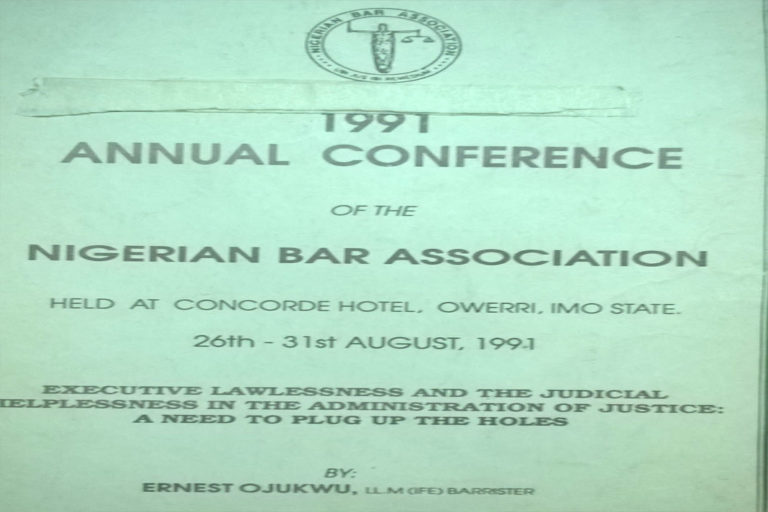
Just about 7 years in the Bar in August 1991 at the AGC of the Nigerian Bar Association held at Concorde Hotel Owerri, Imo State, ‘Teacher’ Prof Ernest Ojukwu SAN presented a paper titled: “EXECUTIVE LAWLESSNESS AND JUDICIAL HELPLESSNESS IN THE ADMINISTRATION OF JUSTICE: A NEED TO PLUG UP THE HOLES” at the full plenary of the AGC.
At that conference, Prof Ojukwu as a young lawyer, suggested at page 9 of his paper that: “Our only hope lies in reforming, reappraising and reorganising the judicial system not only from the point of appointment of personnel but also to the structural imbalance that affects its independence. For once, the Bar should be involved somehow in the selection of judges. Some of the structural changes we suggest are: a multiplier increase in the salary of Judges and Magistrates, an independent funding and budgetary for the judiciary, the appointment and control of supporting staff by the Judicial Service Commission, a special Code of Conduct for judicial officers, an Inspectorate committee for the judiciary, a review of the system of recording in long hand.”
26 years after, the issues raised by the sage and legal Nostradamus are still lingering and begging for solutions.
1991 Annual Conference of the Nigerian Bar Association
Held at Concorde Hotel, Owerri Imo State, 26th – 31st August, 1991
EXECUTIVE LAWLESSNESS AND THE JUDICIAL HELPLESSNESS IN THE ADMINISTRATION OF JUSTICE: A NEED TO PLUG UP THE HOLES.[1]
ERNEST OJUKWU, L.L.M(IFE), BARRISTER AT-LAW
A. INTRODUCTION:
The theme of this conference could not have been better chosen at this “eve” of the third Republic by this premier association. This is because there is a tendency by the populace particularly in the developing world to believe that government is run by lawyers. We have heard it said even by the people in government today in Nigeria that our second Republic failed by the acts and omissions of the lawyers.
This belief may not be totally far-fetched because the lawyers often play very important roles in government and the administration of justice. The beginning of modern Governance starts with the enactment of laws, prepared by a lawyer – be it a decree, an edict, an Act of Parliament or even the constitution of the land. The Lawyer, at least in Nigeria has always been a chief advisor in Cabinet. There are lawyers advising and drafting laws for the legislature. The lawyers constitute in the main the judiciary. We have legal advisers to the political parties and today it is being made mandatory that every local government in the country must appoint a legal adviser.
It is therefore clear that if the lawyer is not to blame again, we must as we have now chosen, address the theme of our conference and suggest ways out for the survival of the third Republic for it has been opined, “In determining a nation’s rank in political civilization, no test is more decisive than the degree in which justice, as defined by the law, is actually realized between one private citizen and another, and as between private citizens and members of the government”.[2] Thus, “when we know how a nation – state dispenses justice, we know with some exactness the moral character to which it can pretend”.[3]
It is our aim therefore to discuss critically the role of the executive and the limitations of the judiciary in the administration of justice in Nigeria and attempt to propound suggestions that can help raise our “rank in political civilization” by the enthronement of a lasting democratic experiment.
B. ADMINISTRATING JUSTICE AND SEPARATION OF POWERS
There is a tendency in this paper to avoid definition of such terms as “Justice” or “Administration of Justice”.
Definitions, said Julius Stone, are “essentially mnemonics for clarification. They may be pre-ambulatory mnemonics foreshadowing elucidation to follow, or summation mnemonics recalling what has already been expounded. In either case a definition cannot fruitfully be more definite or more definitive than the exposition which it calls to mind”.[4] We shall in the circumstance attempt what we may call an exposition of our subject matter rather than defining.
Even at that, the term “Justice” is a nebulous concept with varied meanings in various countries and in different eras. The popular idea of “Justice” is based, even nebulously, on a sense of equality. The term is elusive as that term “public policy”.[5] But one thing is certain; the term “Justice” is an antithesis of arbitrariness.
To “administer Justice” is to dispense Justice. The notion of Justice is fairness and balance of competing interests. The administration of Justice aims at furthering national unity, patriotism, public security, peace, order and good government.[6] President Babangida recently said that “the dispensation of justice… is the heart and soul of all good governments”.6B
It is agreed that the administration of Justice in its broad sense is involved in the exercise of every governmental function, be that function legislative, executive or judicial in nature. In this sense, every step taken by government or its agencies is measured in terms of how far it protects the welfare of the citizens and balances the competing interests. Administration of Justice in this broad sense would therefore include the fairness of the laws enacted by the legislature, the interpretation placed upon such laws by the courts and the opportunities given the courts, the even-handedness of the executive in the implementation not only the letters of the Law but in accommodating the decisions or would be decisions of the courts.[7]
As stated earlier, all arms of government are concerned with the administration of Justice. Under the 1979 constitution (pre-military) and the 1989 constitution, the three branches of government; the Legislature, the Executive and the Judiciary are separate and distinct. This is a follow-up of the Montesquieu doctrine of separation of powers in which a distinction is drawn between the Legislature, Executive and Judicial functions.
The concept of separation of power arose from the ‘need to ensure the restraint of governmental power by dividing that power, without carrying that division to an extreme, incompatible with effective government’. A constitutional democracy thus pre-supposes a balanced system of divided or shared powers. It is only within such a system that individual citizens can ever hope to enjoy any measure of independence and freedom from arbitrariness and governmental lawlessness and thus regain the civil rights and liberties conferred on them by our Constitution.[8]
Though the functions of the three organs are distinct, there cannot be a total separation of powers and the powers given to each other are delicately balanced by powers, given to the other two. Examples of such balance abound in the 1989 Constitution. The aim of government in spite of the separation of powers should be advancement of the common good. In which case, the three co-ordinate powers of the state should, in the words of Hon. Chukwudifu Oputa, “constitutes one brotherhood, working side by side with mutual toleration and co-operation”.[9] We must agree therefore that “The primary end of the state is Justice – the building and the maintenance of a just society ‘where no man is oppressed’, the maintenance of the Juristic order. To this end the Legislature by the laws it passes enunciates the general norms of Justice while the Executive oversees these laws as they apply at large. But the state through the Judiciary pronounces justice in the concrete.[10]
C. THE CREATION AND MISUSE OF EXECUTIVE POWERS
(1) THE CONSTITUTION:
Section 5 of the 1989 Constitution (just like the 1979 Constitutions) vests the executive powers of the Federation, the States, and Local Governments in the President, Governors, and Chairmen of Local Government Councils respectively. Each of these representatives of each tier of Government is restricted to act only in the “area” of his authority as provided by the constitution. The 1989 constitution provides for example, that:
(a) “The executive powers of the Federation shall be vested in the President and may, subject as aforesaid and to the provisions of any law made by the National Assembly, be exercised by him either directly or through the Vice President or Ministers of the Government of the Federation or other officers in the public service of the Federation; and
(b) Shall extend to the execution and maintenance of this Constitution, all laws made by the National Assembly and to all matters with respect to which the National Assembly has for the time being power to make laws”.
Similar provisions are made for the state Governors and Chairmen of Local Governments. The executive representatives of each of the three tiers of government in Nigeria are allowed and in practice do act through other officers of government. Examples are the Police, Federal Road Safety Marshals, the Army, the Customs and Excise men, the Ministers, Commissioners, Directors- General, the Prison Officials, Local Government Supervisors and Secretaries and of course the SSS and a host of other officers. All these play great roles in the administration of justice.
(2) THE MISUSE:
But how has the executive faired in the administration of Justice today in Nigeria? Would it not be axiomatic to ask the executive to RESIT?[11] There is a current trend where court orders and judgments are disrespected with impunity by agents of the three tiers of governments, where the courts are violated and intimidated, where fundamental human rights is sold costlier than the pathfinder Car and the “rule of law” is a paradigm of “rule of the might”.
We are witnesses to the police and security men’s brutality to and the constant abuse of the rights of suspects and detainees,[12] the creation of dud offenses and the unlawful arrests and detention of innocent citizens. Our police stations and cells are so overcrowded particularly at weekends that you wonder whether all citizens have not become criminals. Or have you not heard people boasting to others that “I shall not call the police for you, I will just tell the soldiers at the camp “.
If the citizen truly carries out this threat, the effect would be what you may have to guess. The police, the SSS, the army are not alone. There are catalogues of instances by other agents of the executive, and some of them are reproduced hereunder:
The Ganiyu Oladapo Case
On September 24, 1990, agents of the Lagos State Government accompanied by armed security men, moved bulldozers into a tourist centre situated along Ozumba Mbadiwe Street Victoria Island. The caterpillar rumbled over the property and in a matter of minutes, they had reduced the lagoon front resort to a heap of rubbish. This demolition was the climax of a dispute which began in 1986. The multimillion naira tourist centre was the property of Ganiyu Oladapo, Chief executive of Osa Investment and Property Company. But the parcel of land on which he constructed his tourist paradise was in contention. The Lagos State Government claimed the land and in 1986, it claimed that it gave Osa Investment a quit notice. Oladapo went to court to contest the government’s claim. On September 4, 1990, Oladapo filed an appeal at the Court of Appeal. He followed up the appeal with a motion praying the court to restrain the Lagos State Government from dispossessing him of the land based on the lower court’s ruling.
The appeal was pending when the government roared into the resort, sacked Oladapo and his staff, demolished every structure and set fire to the wooden rubbles. On September 27, the Appeal Court granted the prayer of the plaintiff and restrained the Lagos State Government from acting on the ruling of the High Court. It was too late. But the appeal court had also fixed October 17, 1990 for hearing the substantive appeal. Armed with the order of court Oladapo moved back into the land. In a bid to re-establish possession he put up a fence and temporary structures. On October 15, two days before the substantive appeal, an armed squad of the State government again descended on the place and tore down the temporary structures.
The Gongola State – NBA Case
In Gongola State, Isa Mohammed a Governor established another example of executive lawlessness. In 1989 he refused to swear in two new Chairmen for Numan and Mayo Belwa Local Government Councils after the Court of Appeal had upheld the decision of a Yola High Court nullifying the elections of two other persons. The Governor’s resolve not to comply with the Court order to swear in the runner-up. In the chairmanship elections in the two councils pitted the NBA against the state Government, resulting in the boycott of the Courts by lawyers.
The Hon. Yahaya Jinadu Case
In 1984, Hon. Yahaya Jinadu, a Judge of the Lagos High Court ruled that John Oregun, a Federal Permanent Secretary should appear before him on a charge, of contempt of court. Hon. Jinadu had earlier given judgement in favour of a Federal Fire Officer, Saidu Garba who had sued the government for wrongful termination of his appointment over NECOM house fire disaster in 1983. Jinadu ordered Garba reinstated, but Oregun, then Permanent Secretary Federal Ministry of Internal Affairs refused. Jinadu then issued a bench warrant for the arrest of Oregun but this was treated with utter contempt and it was never served. The Military regime of Buhari/Idiagbon saw Jinadu’s actions as a direct challenge to its authorities and so did everything to frustrate the judicial order of the judge. These and further events in this case culminated in the pre- mature retirement of Hon. Justice Jinadu.
The Festus Iyayi- Uni Ben Case[13]
The University of Benin authorities in 1987 evicted Festus Iyayi, National President of ASUU, Prof. Sagay and John Odita from their official quarters in disregard of an order of a Benin High Court a week earlier.
There are other familiar cases where the executive had acted in the most lawless manner. Examples are:
1. The Shugaba’s Case[14]
2. Obeya Memorial Case[15]
3. Ojukwu’s Villaska Lodge Case[16]
4. Stitch v A-G Federation[17]
5. Afolabi v Governor Oyo State[18]
6. Aliu Bello v A-G Oyo State[19]
7. Olayinan v The University of Lagos[20]
8. Okongwu’s Case – Wherein he was convicted of contempt and while his appeal was pending, the then Governor Jim Nwobodo pardoned him.
9. The practice of the executive in foraging for courts that is likely to have their sympathy as in the Prosecution of Arthur Nwankwo for sedition by the Anambra State Government of Jim Nwobodo.
10. The Saidu Garba Case[21]
We shall return to some of these cases[22] later but for now may we pause and ex-ray the role of our learned brothers – the attorneys- General.
(3) THE ATTORNEY – GENERAL
The Attorney-General who is appointed by the Chief Executive and holds on to his portfolio at the whim of his appointor is the Chief Law Officer be that for his state or for the Federation.
The 1979 constitution provides that the Attorney-General shall have power-
1.
(a) To institute and undertake criminal proceedings against any person before any court of law in Nigeria other than a court martial in respect of any offence created by or under any act of the National Assembly;
(b) To take over and continue any such criminal proceedings that may have been instituted by any other authority or person; and
(c) To discontinue at any state before judgement is delivered, any such criminal proceedings instituted or undertaken by him or any authority or person.
2. …
3. In exercising his powers under this section the Attorney-General shall have regard to the public interest, the interest of justice and the need to prevent abuse of legal process”.[23]
Apart from these provisions of the Constitution, the Attorney-General is the Chief Legal Adviser of Government. In all the cases and instances where governments or its agencies violated the rule of law and disobeyed court orders (even in cases of wide publicity) do the Attorney-General play His primary role- that of advising against arbitrariness? Or does the government act against proper advice?
There seem to be a consensus that some of the Chief Legal Officers do not perform. Sometime in December 1989 the Chief Justice of the Federation granted the African Concord an interview and when questioned “on disobedience of court orders by the Executive Arm of Government”, had this to say:
“Well it is a little problem. The problem is with the Attorney General, not with us. In all the cases where Government refused to comply with such orders, the AGS advice the government that the order is illegal. You see. When a Judge acts out of Jurisdiction, it is illegal. If a Judge releases anybody detained under Decree 2, it is illegal. He has not such power. So if a judge orders someone to be released the Attorney-General will ask the government not to comply. But unfortunately, we think what should have done is to run either to the judge, tell him he has made a wrong order and he should set it aside or go to the Court of Appeal. So normally I don’t blame the government, the Attorney General who should properly advise”.[24]
What of a situation where a bold Attorney-General advises in the best interest of justice and such advice is not heeded? Too many of us will immediately suggest that the Attorney General should resign. It might not be that easy but it is a viable option. It may be further suggested that we review the procedure for the appointment and removal of an Attorney-General.
But on their own as agents of the executive, have the Chief Law Officers (in many Cases) not brutalised and assaulted the rule of law while also recklessly abandoning some of their duties as a major plank in the administration of justice? Some States, we know are so backward in law Reform. Most backward. Has any Attorney-General ever given consent for the attachment of government property? Many governments have rendered court judgements nugatory by not paying the damages awarded against them because of the requirement of consent of the Attorney-General before an attachment of government property. Further examples of the abuse of the Attorney-General’s functions can be found in its constitutional power to enter nolle prosequi.
In one case in 1980 before the High Court of Ondo State in Akure, the accused persons were charged with murder. Because the accused persons belonged to the party in power in the state, the Attorney-General entered a nolle and the accused persons were discharged in a situation in which they would have been tried and either discharged or convicted according to law.[25]
In Imo State was a case of embezzlement of a substantial amount of public funds. The Attorney-General had earlier appeared for the accused while still a private legal practitioner. As soon as he was appointed the Attorney- General, he entered a nolle prosequi on behalf of the said accused.[26]
Another case happened in Kwara State. The civilian Governor had disagreed with the Attorney-General and removed him from office for reasons best known to him. He did not appoint anyone else in replacement. There was then a case pending before the Chief Magistrate’s Court at Ilorin against on Isiaka Sanni and two others, who were political supporters of the Governor and his faction of the political party to which he belonged. The Governor who was a lawyer of more than ten years standing struck a brilliant idea. He appointed himself Attorney-General and Commissioner for Justice in which capacity he signed a purported nolle prosequi, sent it to the DPP with which the case was discharged.[27]
We may conclude this part of our paper by saying that it is a very serious matter for us to enter the third Republic with this trend of recklessness by the executive, high or low. The more serious is the disrespecting of court orders and judgements. The court is truly the last hope for justice. As was said by the Champion Editorial of 18th April 1989, for a nation which is strenuously grooming a polity that respects the rule of law, disrespect of court orders by governors is a clear indication that an aggrieved party should not fall back on the law. The paper asks “what option, other than mayhem and brutish resolution of conflict would there then be left?”
The trend at flouting court orders by the executive arm of government “is a menacing threat to enduring political stability and the evolution of democratic norms”.[28]
D. The Myth and Realities of Judicial Powers:
The judicial powers of the Nation is vested in the Courts whether created by the constitution or by statue and such power “extended to all matters between persons, or between government or authority and any person in Nigeria, and to all actions and proceedings relating thereto, for the determination of any question as to the civil rights and obligations of that person”.[29]
It has been generally acknowledged that the judiciary is the Guardian of our Constitution, the protector of our cherished governance under the Rule of Law, the guardian of our fundamental rights, the enforcer of all the laws without which the stability of society can be threatened, the maintainer of public order and public security, the guarantee against arbitrariness, and generally the only insurance for a just and happy society.[30]
There have been serious attempts to erode the powers of and supervision by the courts in recent times as we have been able to show hereinabove. In some cases the courts particularly the appellate courts have been able to stand firmly against the contemptuous violations of the rights of the citizen and the judiciary by the executive and have spoken out in the strongest terms against the abuse of a healthy justice administration system.
It would be recalled that in the case of Sofekun V. Akinyemi,[31] the Supreme Court had recognised that “…it is essential in a constitutional democracy, such as we have in our country that for protection of the rights of citizens, for the guarantee of the Rule of Law which includes fair trial to the citizen… and, for checking arbitrary use of power by the Executive or its Agencies, the power and jurisdiction of the courts under the constitution must not only be kept intact and unfettered but also must not be nibbled at. To permit any interference with, or a usurpation of, the authority of the courts, as aforestated, is to strike at that bulwark which the constitution gives and guarantees to the citizens, of fairness to him against all arbitrariness and oppression…”
In Saidu Garba V Fred. Civil Service Commission.[32] Garba a former Chief Fire Officer and 19 others detained and arranged before a Chief Magistrate Court on a charge of murder. Garba sought refuge in the High Court of Lagos where his indictment was quashed and he was set free. Following this, he was interdicted by the Permanent Secretary, Ministry of Internal Affairs and suspended on 21st Feb. 1983, on the ground that he was under a criminal trial. He then challenged his interdiction in the High Court but while this was pending, the military came to power and he was dismissed from the public service. Subsequently the High Court declared Garba’s dismissal illegal, null and void and ordered his immediate reinstatement which order was never obeyed.
When the matter finally reached the Supreme Court, the court refused to be cowed by the Military might and affirmed the trial Judge’s decision. The Supreme Court did not hide its feelings on the action of government. Eso, J.S.C said in that case:
“What remains now is an examination of the act of the Respondents in dismissing the Appellant from office during the pendency of the action. Such action, I think is contemptuous of the Judiciary, which has been seized with the determination of civil rights under the constitution and which has been left unscathed by all military coups. For the Judiciary… to operate under the Rule of Law, full confidence,… must exist in that situation… in civil days both the executive and the legislature must show to the entire nation their demonstrable confidence in the Judiciary. The responsibility is greater during military rule… the Rule of Law knows no fear, it is never down; it can only be silenced…”
In the same vain and in the same case, Nnaemeka-Agu, J.S.C. said:
“It is contrary to the letters and spirit of the constitution that any of the three arms should interfere with the other in the performance of its function. If that is allowed to happen, it will lead to chaos, lawlessness and destruction of the constitution. For the permanent Secretary to have proceeded to dismiss the appellant while his case challenging his interdiction in the extreme and a calculated interference with the court’s duty…that ought not to be allowed to stand…”
Similarly in the case of Gov. of Lagos State V Ojukwu,[33] the Supreme Court was unequivocal on its stand on its principle of the Rule of Law. In that case not only did the court dismiss an application brought by the Lagos State Military Government since the court regarded the government’s actions in the case as being in contempt of the lower court, but also criticised it in very harsh words. It would be recalled that while a dispute over the ownership of a house in Lagos between the two parties was pending in court, the Lagos State Military Government, without an order of court, forcibly ejected Chief Ojukwu from the said property. In the words of Eso, J.S.C:
“To use force to affect an act and while under the Marshall of that force, seek the court’s equity, is an attempt to infuse timidity into court and operate a sabotage of the cherished Rule of Law. It must never be!”
While Uwais J.S.C stressed:
“…that it is a matter of grave concern that the military Government of Lagos State should be seen to disregard a lawful order issued by a court of Law. If Governments treat court order with levity and contempt the confidence of the citizen in the courts will be seriously eroded and the effect of that will be the beginning of anarchy in replacement of the Rule of Law”.
At other times the judiciary had been cowed, totally mashed. Sometime in March 1990, a Shagamu High Court gave judgement in the Akarigbo of Remo Chieftaincy dispute that did not favour the state government. The government reacted by promulgating an edict which set aside the High Court order which restrained Governor Mohammed Lawal from installing Mike Sonariwo as the Akarigbo of Shagamu.
In other cases judges were sacked for not toeing the government line and for some their hope of moving to the higher bench or taking their proper precedent sealed. The case for an acting Chief Judge of Lagos State is still fresh in our memory.
Irrespective of some of the appellate court’s assertions against executive recklessness, the court’s current attitude has been described as “timid”, “unbridled cowardice, judicial ineptitude and sheer intellectual laziness”[34] and that “the only way to curb executive lawlessness and legislative arrogance is through fearless judicial activism”. But judicial activism may not be the answer – it may even create more holes.
The judiciary is still in such a weak position in government. It does not on its own execute its orders and judgement, it does not make laws, it does not appoint itself and secure its own tenure, it does not control its own fund, it does not control the appointment of its supporting staff nor does it pay their salary, it does not provide the security at the courts; the salary of judges is too shameful; court records are still kept in long hand; judges still sit two to one court room; and the judiciary’s intervention is based on accident of litigation.
Not totally rejecting the idea of judicial activism, we think that to slow down executive lawlessness, the judiciary must keep asserting itself and live up to its fundamental role, that of protecting the citizens from the wrong and arbitrary exercise power.[35] Let the courts not be afraid that its’ judgements and orders would not be obeyed. Let them be courageous enough to make the orders. Sir Adetokunbo has added one dimension to the solution when he suggests that “the Chief Judges of the states are wholly responsible for this. If they kicked even at the peril of losing their jobs, one will understand it… it is unfortunate that people cannot take that stand today”.[36]
But can the judiciary really help when it is bogged down by its own indiscipline – what late Hon. Justice Nnamani described as the “challenge of credibility”.[37] Accusations against the Bench, low or high abound. Though some of the accusations are mere rumours and false, others are real and proven. Can a person who perverts justice, show partiality, accept bribe and subvert the course of righteousness assert himself? Can a sycophantic, intellectually backward judge assert himself? Can a dishonest, immature person and perennially sick “but I shall not retire” judge assert himself? What of the lazy? We do agree with Sir Adetokunbo Ademola that” a lot is wrong with the appointment of our judges”, and so much depends on the character of the man who is appointed judge.
Incompetent people abound on the bench.
E. Projections, Suggestions and Conclusion
Our only hope lies in reforming, reappraising and reorganising the judicial system not only from the point of appointment of personnel but also to the structural imbalance that affects its independence. For once, the Bar should be involved somehow in the selection of judges. Some of the structural changes we suggest are: a multiplier increase in the salary of Judges and Magistrates, an independent funding and budgetary for the judiciary, the appointment and control of supporting staff by the Judicial Service Commission, a special Code of Conduct for judicial officers, an Inspectorate committee for the judiciary, a review of the system of recording in long hand.
We must not only focus on the bench but also look inwards and address ourselves as members of the bar. What part have we played and would now play collectively and individually in creating a healthy administration of justices system in our Nation.
“The aftermath of the 1983 general elections provided a fertile ground for empirical research into the question of legalism and justice in this country. There can be no doubt that the image of the lawyer and the law he practices became badly dented during the judicial processes which followed those elections”.[38]
Even if we have not performed such empirical research, we still do have a chance as lawyers to create tools which would be adequate to deal with “the menacing octopus”[39] (that is to say, the maladministration of justice) which faces us now and can destroy the third Republic and our country.
The Nation owes our Courts a duty of care. As said by Hon. Obaseki, we “should not by negligence wreck it and turn round to blame the occupants. Wreck the courts and you wreck the nation. Strengthen and elevate the courts and you strengthen and elevate the nation”.[40]
Some critiques[41] while commenting on some attempts by the courts to assert it in judgements have lamented that the judiciary only blows “Sad” “muted trumpets”. Let them “blow the trumpet” even if “muted”. One day it would grow loud (and articulate) enough to stiffen the nerves of a reckless executive.
ENDNOTES
[1] Test of paper presented at the conference of the Nigerian Bar Association held at Owerri, August 26th -31st on the theme “The Administration of Justice: A panacea for the 3rd Republic”.
[2] By Henry Sidgwick, Elements of Politics p.481, quoted by Awa U. Kalu, “Socio Economic considerations in the Administration of Justice”, Conference Paper of the Nigeria Association of Law Teachers. 1985.
[3] Harold Laski, A Grammar of Politics, p.542
[4] Legal System and Lawyers’ Reasoning. P.184 cited by Dias, R.W.M, Jurisprudence 4th edition., London Butterworth, 1967, p.10
[5] Adene V. Dantumbu (1988) 4 N.W.L.R.Pt.88, 309, per Achike, J.C.A at 319.
[6] Haruna, I.B.M. “administration of Justice in Military Era”, in Osinbajo, Y, ed., Towards a Better Administration of Justice in Nigeria. Fed. Min of Justice, 1990, p.69
6B Quoted late Nnamani, J.S.C, see foot note infra
[7] See Awa U. Kalu, Supra.
[8] Hon. Chukwudifu Oputa, “The Independence of the Judiciary in a Democratic Society- Its need, its positive and Negative Aspects,” (1990) Justice Vol. 1 No.3 p.18.
[9] Supra
[10] Hon Chukwudifu Oputa, supra. P.18.
[11] A common palace at the Universities for a second attempt at an examination
[12] Femi Falana, “The Abuse of the Rights of suspects and Detainees in Nigeria, “Law and Practice (1988) Sept-Oct, p.7 – 14; Iyayi, Festus (Dr), “Experience in Detention”, Law and Practice (1988(Sept-Oct, p. 15 – 19.
[13] For this case and the earlier cited three, see “Assault on Rule of Law”, News watch, November 12, 1990.pp. 12-18.
[14] (1981) 2 NCLR, 459
[15] (1987) 3 NWLR (Pt.60) 325.
[16] (1986) 1 NWLR (Pt.18) 621.
[17] (1986) 5 NWLR (Pt. 46) 107.
[18] (1985) 2 NWLR (Pt.9) 734.
[19] Supra
[20] Supra
[21] (1988) 1 NWLR (Pt.71) 449
[22] Note that there are too many cases that never went to the courts
[23] See S. 160 and now S. 179, 1989 constitution.
[24] Reproduced in Sagay, I.E, “The Decline of the Judiciary as an effective and Independent third arm of Government”, The Lawyer (1991), pp.92-93.
[25] See Augustine Nnamani, J.S.C (late), “Abuse of Judicial Process”, Conference of all Nigeria Judges conference, Abuja, 1988.
[26] See the statement, Tuesday 11, August 1987.
[27] Narrated by Hon. Ekundayo and reproduced in Ajomo, M.A., “Nolle Prosequi, An Unquestionable Tool in the Hand of Attorney-General”, Osinbajo Y, ed., Towards a Better Administration of Justice in Nigeria, pp. 23-24.
[28] The Guardian editorial of 27, August 1990.
[29] See S. 6 of the 1979 and 1989 constitutions.
[30] The words of the late Hon. Justice Nnamani, “The Judiciary in the 1990s: Expectation and Challenges”, (1990) Justice, Vol. No. 3 p.27.
[31] (1980) 5 – 7 S.C 1, per Aniagoln, J.S.C p.25 – 26.
[32] (1988) 1 NWLR Pt. 71, 449.
[33] (1986) 1 NWLR Pt. 18, 621
[34] Ozekhome, Mike, “Decrees, Ouster Clauses and Judicial Ineptitude”, Law and Practice, August 1989, p. 6.
[35] Newglobe, commentary, Jan. 13 1986, p.12.
[36] Interview by Newglobe, January 13 1986.
[37] “The Judiciary in the 1990s: Expectation and Challenges; Supra.
[38] Aguda, T.A The Crisis of Justice, Akure, Eresu Hills Publishers , 1986, p.7
[39] Aguda T.A. Supra
[40] His valedictory
[41] Ozekhome, Mike, supra, for example.